 📖 Read & Listen Free
Once upon a time, at the very edge of a great dark forest, there stood a small wooden cottage with a thatched roof and a garden so overgrown that the gate could barely open. In this cottage lived a woodcutter named Heinrich, his wife Marta, and his two children from his first marriage, a boy named Hansel and a girl named Gretel. Heinrich was a good man, quiet and hardworking, with broad shoulders and rough hands that knew every kind of tree in the forest by the feel of its bark. He loved his children deeply, though he was not always good at showing it, being the sort of father who expressed his love through actions rather than words, mending Gretel's shoes before she noticed they were worn, whittling a little wooden horse for Hansel and leaving it on his pillow without saying a word. His first wife, the children's mother, had died when Gretel was barely three, and the grief of it had settled into Heinrich like water into wood, changing him slowly from the inside, making him quieter, heavier, more prone to staring into the fire on winter evenings with an expression that his children could not read.
Marta, his second wife, was a different sort of person entirely. She was thin and sharp-featured, with a pinched mouth and eyes that were always calculating, always measuring, always working out how much things cost and how little she could spend. She had married Heinrich because he had a house and a trade, and she resented the children because they ate food and wore clothes and took up space that she would rather have kept for herself. She was not wicked in the grand, dramatic way of witches in fairy tales. She was wicked in the small, grinding, everyday way that is much more common and in some ways much worse: a sharp word here, a withheld kindness there, a look of irritation when the children laughed too loudly at the table. Hansel and Gretel knew she did not love them. They accepted it with the quiet, heartbreaking resilience of children who have no choice. They had each other, and they had their father, and for a time, that was enough.
But times grew hard. The winter came early that year, and it was brutal. The snow fell in great, smothering blankets, covering the forest and the fields and the roads until the world was nothing but white. The woodcutter could not work. No one wanted firewood when the roads were impassable and the markets were closed. The family's savings dwindled, coin by coin, like sand running through an hourglass. The pantry that had been comfortably full in autumn was nearly bare by December. Marta counted every crust of bread, every last potato, every scraping of butter. She doled out meals in portions that grew smaller and smaller, and the children went to bed hungry more nights than not, lying awake in their little room under the eaves, listening to their stomachs growl. Hansel, who was ten, old enough to understand what was happening, would give half his bread to Gretel when he thought no one was looking. Gretel, who was eight and sharp as a needle, always noticed, and always tried to give it back.
One night, when the children were supposed to be asleep, Hansel heard his father and stepmother talking in the kitchen below. Their voices were low, but in the small cottage, sounds traveled easily through the thin wooden floors. Hansel crept to the top of the stairs and listened. What he heard made his blood turn to ice. 'We cannot feed four mouths,' Marta was saying, her voice flat and matter-of-fact. 'We can barely feed two. Tomorrow you will take the children into the forest and leave them there. Someone will find them, or they will find their own way. Either way, we will survive.' There was a long silence. Then Heinrich's voice, broken and barely audible: 'They are my children.' 'And they will starve here,' Marta replied. 'We all will. Is that what you want?' Another silence, longer this time. Then a sound that Hansel would remember for the rest of his life: his father weeping. Quietly, hopelessly, like a man who had already lost the argument and knew it.
Hansel crept back to bed, his heart hammering. Gretel was awake, her dark eyes wide in the moonlight. 'What is it?' she whispered. 'What did they say?' Hansel told her. He told her everything, because he had always told Gretel everything, and because lying to her would have been worse than the truth. Gretel listened without tears, her small jaw set, her hands clenched in the blanket. When he finished, she was quiet for a long moment. Then she said, 'We will need a plan.' Hansel nodded. He already had one. He waited until the house was silent, until his father's weeping had stopped and the only sound was the wind moaning around the eaves, and then he crept downstairs, unlatched the door as quietly as he could, and stepped outside into the frozen night. The moon was full and the snow glittered like a field of diamonds. Hansel filled his pockets with small white pebbles from the garden path, smooth and round and bright in the moonlight. Then he crept back inside, climbed into bed, and told Gretel his plan.
The next morning, Heinrich woke the children early. His face was haggard, his eyes red-rimmed. 'Get dressed,' he said, not meeting their eyes. 'We are going into the forest to gather wood.' Marta gave them each a small piece of bread for lunch. Hansel broke his into tiny pieces and slipped it into his pocket alongside the pebbles. They set out into the forest, Heinrich walking ahead with his axe over his shoulder, the children following behind. The path led deep into the trees, deeper than Hansel and Gretel had ever been before, past the familiar landmarks, the split oak, the mossy boulder, the stream with the little wooden bridge, and on into parts of the forest that were dark and dense and utterly unknown. But as they walked, Hansel dropped the white pebbles behind him, one by one, spaced evenly along the path. They fell into the snow and lay there, small and bright, like a trail of tiny white stars leading back toward home.
Heinrich took them to a clearing deep in the forest and told them to wait while he went ahead to find good wood. He built them a small fire, and his hands were shaking so badly that it took him three tries to get the flint to spark. He could not look at them. When the fire was burning, he kissed each of them on the top of the head, said, 'I will be back soon,' and walked away into the trees. He did not come back. The children sat by the fire and waited, and the hours passed, and the shadows grew longer, and the fire burned down to embers, and still he did not come. Birds called in the darkening canopy. A fox trotted across the far edge of the clearing, paused to look at them with curious amber eyes, and disappeared into the undergrowth. The cold crept in. Gretel moved closer to her brother and put her hand in his. 'He is not coming back, is he?' she said. Hansel shook his head. 'No. But we know the way home.'
They waited until the moon rose, full and white and bright enough to read by, and then they followed the trail of pebbles back through the forest. The pebbles glowed in the moonlight, each one a tiny beacon, and Hansel and Gretel followed them like sailors following the stars, through the dark trees and the deep shadows and the strange, unsettling noises of the forest at night. Owls hooted. Twigs snapped under the feet of unseen animals. Once, something large crashed through the undergrowth nearby, and they froze, clutching each other's hands, barely daring to breathe. But nothing emerged, and after a moment they kept walking, their bare feet crunching softly in the frozen snow. It took them most of the night, but when the first grey light of dawn appeared on the horizon, they saw the cottage. The gate, the overgrown garden, the thatched roof, the thin curl of smoke from the chimney. They were home.
Heinrich wept when he saw them. He pulled them into his arms and held them so tightly that Gretel could feel his heart beating through his chest, fast and hard and full of a desperate, guilty love. He fed them what little food remained, heated water for them to wash, and put them to bed in their little room, and for a few days things were almost as they had been before. But Marta's resentment was sharper than ever. She looked at the children with her calculating eyes and began to plan again. Two weeks later, on another bitter night when the wind howled and the snow fell, Hansel heard them talking again. The same argument. The same outcome. This time, when Hansel crept to the door to gather pebbles, he found it locked. Marta had anticipated him. The bolt was thrown, and no amount of careful, quiet pulling would budge it. Hansel stood in the dark hallway with his empty pockets and his racing heart, and for the first time, he did not have a plan.
In the morning, Heinrich took them into the forest again. This time, Hansel crumbled his piece of bread and dropped the crumbs behind them as they walked, tiny white specks on the white snow. It was the only thing he could think of. But the forest was full of birds, hungry winter birds with sharp eyes and empty bellies, and as fast as Hansel dropped the crumbs, the birds swooped down and ate them. By the time they reached the clearing, deep, deep in the forest, deeper than before, the trail was gone. There was nothing behind them but trees and snow and silence. Heinrich made them a fire, larger this time, as if the size of the fire could compensate for the size of his guilt. He held them both for a long time, his rough hands trembling on their shoulders, and then he walked away, and this time Hansel knew he would not come back, and he knew there was no trail of bright pebbles waiting to guide them home.
They were lost. Truly, completely, terrifyingly lost. The forest stretched in every direction, vast and indifferent, the trees standing like tall, silent sentinels wrapped in snow. There were no paths, no markers, no footprints but their own, and even those filled in quickly as fresh snow continued to fall in soft, relentless curtains. Hansel and Gretel held hands and walked, because walking was better than sitting still, and because the cold would kill them faster than the hunger if they stopped moving. They walked all day, stumbling through drifts and scrambling over fallen logs, their breath rising in white clouds, their fingers and toes numb despite their worn mittens and thin boots. They saw no path, no clearing, no sign of human habitation. The forest was endless. Once they heard the sound of chopping in the distance, and they ran toward it, shouting, their voices cracking with hope, but when they reached the spot they found only a woodpecker hammering at a dead tree, its bright red head bobbing rhythmically against the pale bark. As night fell, they found shelter in the hollow of a great fallen beech tree, its trunk wider than a cart, its bark rough and cold against their backs. They huddled together inside, pulling dead leaves over themselves for warmth, and Gretel sang softly, a lullaby their mother used to sing, and Hansel listened with his eyes closed, and the song was the only warm thing in the whole frozen world. They slept fitfully, waking often to the sounds of the forest at night, the hoot of an owl, the distant howl of a wolf, the creak and groan of branches under the weight of ice.
They walked for three days. On the morning of the third day, hungry and exhausted and on the very edge of despair, they smelled something. It drifted through the cold air like a whisper, faint at first, then stronger: the unmistakable scent of gingerbread. Rich, sweet, spicy gingerbread, the kind that bakers make at Christmas, studded with raisins and glazed with honey. Hansel and Gretel looked at each other. 'Do you smell that?' Gretel whispered. Hansel nodded. His stomach clenched with hunger so fierce it was almost painful. They followed the scent through the trees, pushing through a thicket of snow-laden brambles, and emerged into a clearing that made them both stop and stare, their mouths hanging open, their eyes wide with disbelief.
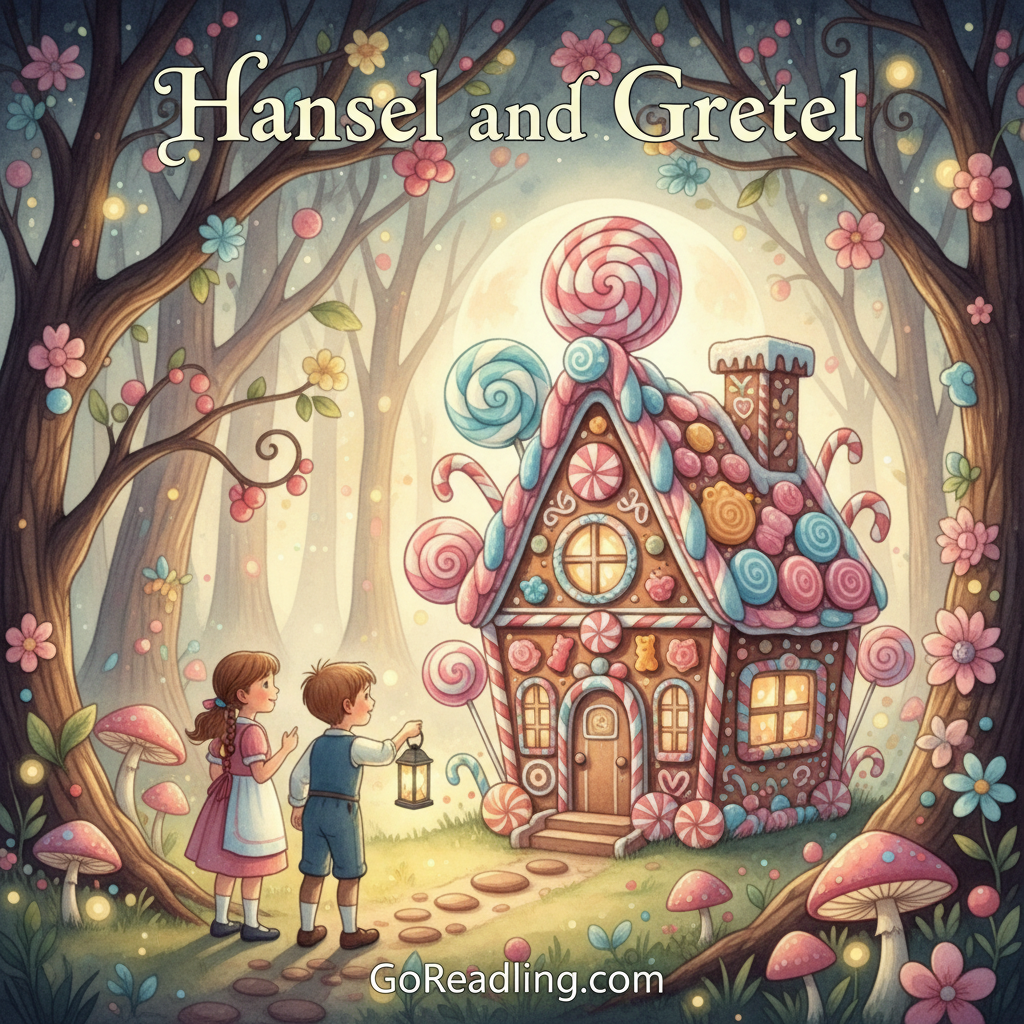
In the center of the clearing stood a house made entirely of food. The walls were built of thick gingerbread slabs, brown and fragrant, mortared together with swirls of white royal icing that had been piped in elaborate patterns, loops and flowers and tiny stars. The roof was tiled with slabs of chocolate, dark and glossy, each one perfectly overlapping the next like proper roof tiles. The windowpanes were made of clear spun sugar, sparkling in the winter sunlight like sheets of amber glass, and through them Hansel could see the warm glow of a fire burning inside. The door was a great slab of marzipan, painted with food coloring to look like wood, and the handle was a twisted barley sugar stick, golden and gleaming. Candy canes stood in neat rows along the front like a picket fence, red and white stripes bright against the snow. Gumdrops of every color lined the windowsills, green and red and orange and purple. Licorice spirals decorated the eaves. Spun sugar icicles hung from the gingerbread gutters, catching the light and sending tiny rainbows dancing across the snow. The chimney was made of stacked brownies, and sweet-smelling smoke rose from it, carrying the scent of cinnamon and nutmeg and vanilla into the cold December air. It was the most extraordinary, impossible, wonderful thing either child had ever seen. Gretel reached out and touched the wall, almost expecting her hand to pass through it like a mirage. But it was solid. 'This cannot be real,' she said. But it was. Hansel broke off a piece of the windowsill. It was gingerbread, warm and fragrant and absolutely delicious. Gretel pulled a gumdrop from the wall and put it in her mouth, and the sweetness of it, after three days of nothing, brought tears to her eyes.
They were so hungry that they forgot to be cautious. They forgot every lesson their father had ever taught them about being careful with strangers and strange places. The hunger erased everything except the need to eat. They broke off pieces of gingerbread and stuffed them into their mouths, they pulled candy canes from the fence and sucked on them, they scraped icing from the walls with their fingers. Hansel pulled an entire shutter off its hinges and bit into it, chocolate, thick and dark and rich. Gretel found that the doorstep was made of shortbread, crumbly and buttery and perfect. They ate and ate, laughing and crying at the same time, the relief and the sugar making them giddy. They were so absorbed in eating that they did not hear the door open. They did not notice the figure watching them from the doorway, a stooped, thin old woman leaning on a gnarled stick, her eyes bright and sharp behind a pair of thick spectacles, her smile wide and warm and not entirely convincing. 'Well, well,' she said, in a voice like honey poured over gravel. 'What dear little children. You must be so hungry. Come inside, come inside. I have soup and warm bread and soft beds for tired travelers.'
They should have been suspicious. Gretel, who was the more cautious of the two, felt a prickle of unease at the back of her neck. But the warmth that poured out of the open door was irresistible, and the smell of the soup was rich and savory, and the old woman's hands were gentle as she guided them inside. The interior of the house was as strange as the outside, walls of gingerbread, shelves lined with jars of candy, a fireplace built of toffee bricks. But it was warm, gloriously warm, and there was soup on the table, thick vegetable soup with chunks of potato and carrot, and fresh bread still steaming from the oven, and butter, real butter, golden and soft. The children ate until their stomachs were full for the first time in weeks. The old woman watched them with her bright, sharp eyes and smiled her wide smile and said, 'You poor darlings. You must stay here with me. I will take care of you.' She showed them to a little bedroom with two clean beds and warm quilts, and Hansel and Gretel fell asleep instantly, deeply and dreamlessly, like stones sinking into dark water.
Hansel woke to the sound of metal. A click, a clang, the grinding of a lock. He opened his eyes and found himself not in the soft bed where he had fallen asleep, but in a cage. An iron cage, the kind used to hold animals, with thick bars and a heavy door secured by a padlock. He was in the kitchen of the gingerbread house, and the old woman was standing over him, but she was not the same woman who had fed them soup. Her stoop was gone. Her spectacles were gone. Her warm smile was gone. In its place was something sharp and hungry, a face that was all angles and shadows, with eyes that gleamed like hot coals and teeth that were long and yellow and pointed. She was a witch. The gingerbread house, the candy, the warm soup, all of it was a trap, a sweet, irresistible lure designed to draw hungry children into her clutches. Hansel gripped the bars and shook them, but they were solid iron and did not budge. The witch laughed. It was not a pleasant sound.
'You,' she said to Hansel, poking him through the bars with a bony finger, 'are too thin. I shall fatten you up before I eat you.' She turned to Gretel, who was standing in the doorway of the bedroom, her face white with shock and fear. 'And you,' the witch said, 'will do the cooking. Get to work.' And so began the worst days of Hansel and Gretel's young lives. Every morning, the witch would waddle over to Hansel's cage and demand that he stick out his finger so she could feel how fat he was getting. But the witch's eyesight was terrible, a fact that Hansel discovered quickly and exploited ruthlessly. Instead of his finger, he would stick out a chicken bone, thin and hard, and the witch would pinch it and scowl. 'Still too thin,' she would mutter. 'More cake. More bread. More butter.' And she would pile more food into the cage, and Hansel would eat it gratefully, knowing that every day the deception worked was another day of life.
Gretel, meanwhile, was forced to work. She cooked and cleaned and scrubbed and carried, fetching water from the well and wood from the pile and flour from the pantry. The witch was a cruel and demanding taskmaster, screaming and cursing when a meal was not to her liking, striking Gretel across the knuckles with a wooden spoon when she moved too slowly. The days were long and exhausting, and at night Gretel would collapse on the hard kitchen floor, every muscle aching, and whisper to Hansel through the bars of his cage. They talked in voices so soft that not even the mice in the walls could hear them. They talked about home and their father and the garden and the stream where they used to catch tadpoles in the spring. They talked about what they would do when they escaped, not if but when, because Gretel refused to use the word if. But Gretel bore it all with a grim, quiet determination that the witch mistook for obedience. Gretel was not obedient. Gretel was planning. She watched the witch carefully, noting her habits, her weaknesses, her routines. She noticed that the witch always stoked the oven in the late afternoon, building it to a ferocious heat for the evening's baking. She noticed that the witch was nearly blind, relying on touch and smell rather than sight. She noticed that the witch kept the key to Hansel's cage on a chain around her neck, and that she removed it only when she slept. And she waited.
Four weeks passed. The witch grew impatient. 'Fat or thin, I will eat the boy tomorrow,' she announced one morning, glaring at the chicken bone Hansel had once again offered through the bars. 'Light the oven, girl. Make it hot. Hotter than you have ever made it. We will need a fire fit for roasting.' Gretel's stomach dropped, but her face showed nothing. 'Yes, ma'am,' she said. She built the fire carefully, feeding it with dry wood until the flames roared and the air above the oven shimmered with heat. The witch watched with eager, glittering eyes, rubbing her bony hands together. 'Is it hot enough?' the witch demanded after an hour. 'I am not sure,' Gretel said, her voice small and innocent. 'I am just a child. I do not know how to tell if an oven is hot enough. Could you show me? Could you lean in and check?' The witch scowled. 'Stupid girl,' she muttered, and shuffled toward the oven.
She reached for the oven door and bent forward to peer inside, her long, crooked nose silhouetted against the orange glow. This was the moment Gretel had been waiting for. She had been waiting for weeks, carrying water and wood and rage and patience, carrying the weight of her brother's life on her small shoulders, and now the moment was here and she did not hesitate. She stepped forward, planted both hands firmly on the witch's back, and pushed. The witch tumbled forward into the blazing oven with a shriek that shook the gingerbread walls. Gretel slammed the iron door shut and threw the bolt. It was done. She stood there, breathing hard, her hands trembling, the heat of the oven scorching her face. Then she turned, found the key on its chain where the witch had set it down, ran to her brother's cage, and unlocked it. Hansel stumbled out and wrapped his arms around her, and they stood there in the kitchen of the gingerbread house, holding each other, shaking, crying, alive.
When they had caught their breath, they explored the house. Behind a curtain in the witch's bedroom, they found chests, heavy wooden chests banded with iron, and when they lifted the lids, the light that poured out made them gasp. Gold coins, strings of pearls, rubies and emeralds and sapphires that glowed like captured fire. The witch had been hoarding treasure for years, decades perhaps, the accumulated wealth of every poor traveler and lost child who had stumbled upon her gingerbread trap. Hansel and Gretel filled their pockets and their mittens and their hats with as many jewels and coins as they could carry. They took bread and cheese and dried fruit from the pantry. They put on warm coats they found hanging by the door, proper coats lined with fur, far better than the thin jackets they had arrived in. Gretel found a pair of sturdy leather boots that fit her, and Hansel found a thick woolen scarf. They took one last look at the gingerbread house and then they left it behind, walking out into the winter forest with their pockets heavy and their hearts light.
Finding their way home was easier than they expected, as if the forest, having held them prisoner for so long, had decided to let them go. A white bird appeared on a branch ahead of them, singing a clear, sweet song, and every time they lost their way, it flew to the next branch and the next, leading them gently through the snow-covered trees. They crossed a frozen stream by walking carefully along a fallen log, holding each other's hands for balance, their boots slipping on the icy bark. They passed through a grove of silver birch trees so beautiful that Gretel stopped and stared, the pale trunks gleaming in the winter sunlight like pillars of pearl, their papery bark peeling in delicate curls. They rested there briefly, eating some of the bread and cheese from the witch's pantry, and Hansel carved a small notch in one of the birch trees with his pocketknife, a mark for the future, a way of remembering. By late afternoon they reached the edge of the forest, and there, at the bottom of the hill, was the cottage with its thatched roof and its overgrown garden and its thin curl of chimney smoke. Their father was in the garden, splitting wood, and when he looked up and saw them, the axe fell from his hands and he ran to them, stumbling through the snow, his arms outstretched, his face transformed by a joy so fierce it was almost unrecognizable.
He told them that Marta had left. She had packed her belongings one cold morning, taken what little money remained in the jar on the mantelpiece, and gone to her sister in the next village without a word of goodbye or a backward glance. Heinrich had been alone in the cottage for weeks, alone with his guilt and his grief, barely eating, barely sleeping, tormented by the knowledge of what he had done. He had tried to find them. He had gone into the forest three times, searching, calling their names until his voice was raw, but the forest was vast and the snow covered every track and he had found nothing. He had given them up for dead, and the thought had nearly destroyed him. Now here they were, alive and well, their pockets stuffed with treasure, and he held them in his arms and wept and begged their forgiveness. Hansel and Gretel looked at each other over their father's shaking shoulders, and in that look was something complicated and painful, a mixture of love and hurt and understanding that was far too old for children of ten and eight. They forgave him. Not easily, and not all at once, but they forgave him, because he was their father, and because forgiveness, like bread, is something that sustains you even when it is hard to swallow.
The witch's treasure changed their lives. Heinrich used it wisely, as a man who has learned the bitter cost of poverty always does. He bought more land, good flat land with rich dark soil that was perfect for growing vegetables and wheat. He hired workers and built a proper workshop where he could craft fine furniture as well as chop firewood, sturdy oak tables and elegant chairs and beautiful carved cabinets that people came from miles around to buy. The cottage was repaired and expanded, with proper bedrooms for the children, each with a real bed and a feather mattress and a warm woolen blanket, and a kitchen with a proper iron stove and copper pots and a pantry that was always, always full. Hansel and Gretel were sent to school in the village, where they made friends and learned to read and write and do arithmetic. They grew up strong and capable, shaped by their ordeal but not broken by it. Hansel became thoughtful and cautious, a young man who always had a plan and always carried a pocketful of white pebbles, just in case. Gretel became fierce and brave and unsentimental, a girl who could stare down any bully and who always, always checked the oven before she turned her back on it.
Years later, on a warm summer evening, Hansel and Gretel sat together in the garden of their rebuilt home. The roses were in bloom and the bees hummed lazily among the flowers. Their father was inside, reading by the fire, older now and gentler, his guilt softened by time and the patient, stubborn love of his children. Hansel poured two glasses of lemonade and handed one to Gretel. 'Do you ever think about the forest?' he asked. 'Sometimes,' Gretel said. 'I dream about it occasionally. The gingerbread house. The cage. The witch.' She was quiet for a moment. 'But mostly I think about the bird. The white bird that led us home. I have never been able to explain that.' Hansel nodded. 'Perhaps some things are not meant to be explained,' he said. 'Perhaps they are just meant to be grateful for.' Gretel smiled. The evening light was warm and golden, and somewhere deep in the hedgerow a blackbird was singing its beautiful heart out, and the whole world was peaceful and warm and safe and good.
And that, dear little one, is the story of Hansel and Gretel, two brave children who faced the darkest depths of the forest and found their way home again. Remember, as you lie in your cozy bed tonight, that even in the scariest moments there is always something to hold onto, a brother's hand, a sister's courage, a trail of bright pebbles in the moonlight. Be brave, be clever, and never stop looking for the path that leads you home. The world is full of dangers, yes, but it is also full of white birds and warm kitchens and people who love you more than you know. Goodnight, little one. Sleep well, and dream of a world where the forests are friendly and every path leads safely to your door.