 📖 Read & Listen Free
Once upon a time, in a wide green meadow at the edge of a forest where the wildflowers grew tall and the bees hummed lazy songs all day long, there lived a hare. Now, this was no ordinary hare. His name was Hartley, and he was the fastest animal anyone in the meadow had ever seen. He could sprint from one end of the field to the other in the time it took a sparrow to blink. He could outrun the foxes, the deer, the rabbits, and even the swallows that swooped low over the grass on summer evenings. His legs were long and powerful, and when he ran, he was a blur of tawny fur and flashing white tail, moving so fast that the buttercups bent in his wake and the dandelion seeds scattered like tiny parachutes. Hartley knew he was fast. He knew it the way the sun knows it is bright and the river knows it is wet. It was simply a fact of his existence, as certain and unchangeable as the sky being blue. And because he knew it so well, and because everyone else knew it too, Hartley had become, over years of easy victories and effortless triumphs, rather proud of himself. Not just proud. Insufferably, spectacularly, magnificently proud.
Every morning, Hartley would stretch his long legs in the meadow and challenge anyone who happened to be passing to a race. 'Good morning, Squirrel!' he would call out. 'Fancy a race to the old oak tree?' The squirrel would shake his head and scurry away. 'Hello there, Hedgehog! Race you to the pond!' The hedgehog would curl into a ball and pretend to be asleep. 'Badger! Sparrow! Field Mouse! Anyone?' Nobody wanted to race Hartley, because nobody could win, and losing to Hartley was particularly unpleasant, not because he was cruel, but because he was so very, very pleased with himself afterward. He would prance around the meadow, his chin held high, his ears pointing straight up like two furry flagpoles, telling anyone who would listen, and many who would not, about his latest victory. 'Did you see that? Did you see how fast I was? I barely even tried! I could have done it with my eyes closed! I could have done it hopping on one leg!' The other animals would nod politely and find somewhere else to be.
On the other side of the meadow, near a quiet stream that trickled over smooth stones and wound its way through a patch of soft moss, there lived a tortoise. Her name was Tilly, and she was, by any reasonable measure, the slowest creature in the meadow. She was old, though no one knew exactly how old, and her shell was a beautiful dome of dark green and brown, worn smooth by decades of sun and rain. She moved through the world at a pace that could only be described as deliberate. Each step was careful, considered, and placed with the quiet precision of someone who understood that the ground beneath her feet was worth paying attention to. She noticed things that the other animals missed entirely: the tiny blue flowers that grew between the stones, the way the light changed color as it filtered through the leaves at different times of day, the particular sound the stream made when it passed over the flat grey rock versus the round white one. She had been walking the same paths through this meadow for longer than most of the other animals had been alive, and she knew every inch of it with a deep, unhurried intimacy.
Tilly did not mind being slow. She had made peace with it long ago, the way one makes peace with the shape of one's nose or the sound of one's voice. It was simply who she was. She could not run, could not leap, could not dash or dart or sprint. But she could walk, steadily and surely, for hours and hours without stopping, putting one sturdy foot in front of the other with a patience that was almost hypnotic to watch. The other animals respected Tilly. She was kind and wise and always had time to listen to their problems, which she did with her ancient, thoughtful eyes and her habit of nodding very slowly before offering advice that was invariably sensible, practical, and right. When the young rabbits quarreled, they went to Tilly. When the birds could not agree on the best place to build a nest, they asked Tilly. She was the meadow's quiet anchor, steady and reliable, always there, always the same, like the old oak tree or the stream or the hills on the horizon.
One especially lovely spring morning, Hartley was in particularly fine form. He had just raced a young deer and won by such a margin that the deer was still at the halfway point when Hartley crossed the finish line, turned around, ran back to the halfway point, and crossed the finish line again. He was now prancing through the meadow, recounting this triumph to anyone within earshot. 'Twice!' he was saying to a pair of unimpressed ducks. 'I ran the course twice in the time it took him to run it once! I am not just fast, I am impossibly fast. I am historically fast. There is no animal in this meadow, in this forest, in this entire country, who could beat me in a race. It simply cannot be done.' He paused for dramatic effect. 'I am,' he declared, 'unbeatable.' And from the mossy bank by the stream, a quiet, unhurried voice said, 'I will race you.' Every animal in the meadow turned to look. It was Tilly.
A stunned silence fell over the meadow. A butterfly, which had been drifting peacefully past, stopped in midair and hovered, as if it too could not believe what it had just heard. Hartley stared at Tilly. Tilly looked calmly back at him. 'You?' Hartley said, and then he laughed. It was a big, braying laugh that echoed across the meadow and startled the crows out of the elm tree. 'You want to race me? You, the slowest creature in the entire meadow, want to race me, the fastest?' He laughed so hard he had to sit down. He laughed so hard that tears ran down his furry cheeks. He rolled in the grass, kicking his long legs in the air. The other animals watched in embarrassed silence. Tilly waited. She did not seem offended. She did not seem anything at all, really, except patient. When Hartley's laughter finally subsided to occasional hiccups and snorts, she said, simply and clearly, 'Yes. I want to race you. Tomorrow morning. From the old stone wall to the big chestnut tree on the hill. Do you accept?'
Hartley wiped his eyes and grinned. 'Of course I accept! This will be the easiest race of my life. I will enjoy it immensely.' He bounded away, already planning how he would tell the story of his ridiculous victory for weeks to come. The other animals gathered around Tilly, worried and confused. 'Tilly, what are you doing?' asked the squirrel. 'You cannot possibly win. He is a hundred times faster than you.' 'A thousand times,' corrected the hedgehog helpfully. Tilly smiled her slow, gentle smile. 'Perhaps,' she said. 'But speed is not the only thing that matters.' She said nothing more, no matter how much they pressed her, and eventually she wandered back to her mossy bank by the stream and settled in for the evening, watching the sunset paint the sky in shades of peach and lavender. The other animals whispered among themselves. Most thought Tilly had lost her mind. A few, the older and wiser ones, were not so sure. There was something in Tilly's calm, steady eyes that suggested she knew something they did not.
The next morning dawned bright and beautiful. The sun rose over the hills in a blaze of gold, and the dew on the grass sparkled like scattered diamonds. It seemed as though every creature in the meadow and the forest had come to watch the race. Squirrels perched in the branches. Rabbits lined the route. Birds sat on fence posts and tree stumps. Even the fish in the stream seemed to be paying attention, their silver bodies catching the light as they drifted near the surface. The old stone wall stood at one end of the meadow, grey and mossy and ancient, and far away, up the long gentle slope of the hill, the big chestnut tree spread its branches against the blue sky. The distance between them was considerable. It was not a short sprint but a long, winding course that climbed steadily uphill, through the meadow, across the stream, through a patch of wildflowers, past the old oak, and up the final slope to the finish line at the chestnut tree.
Hartley arrived at the starting line looking splendid. He had groomed his fur until it gleamed. He stretched his long legs ostentatiously, touching his toes, doing high kicks, making a great show of his preparations. He bounced on the spot, his powerful haunches coiling and releasing with explosive energy. The crowd murmured with admiration. He was, there was no denying it, a magnificent athlete. Then Tilly arrived. She plodded up to the starting line at her usual unhurried pace, her ancient shell rocking gently from side to side, her wrinkled face calm and composed. She did not stretch. She did not bounce. She simply took her place beside Hartley and looked up at the hill in the distance with a quiet, steady gaze. 'Are you sure about this?' Hartley asked, not unkindly. He was feeling generous in his certainty. 'Quite sure,' Tilly replied. The old owl, who had agreed to start the race, cleared his throat. 'On your marks,' he hooted from his branch. 'Get set. Go!'
Hartley exploded off the starting line like a firework. One second he was there, the next he was a distant blur of fur, his powerful legs eating up the ground in great bounding leaps. Within moments he had crossed the first field and was approaching the stream. Tilly, meanwhile, took her first step. Then her second. Then her third. By the time she had taken her tenth step, Hartley was already out of sight. The crowd fell silent. Some of the younger animals giggled. The squirrel shook his head sadly. It was over before it had begun, or so it seemed. But Tilly did not look discouraged. She did not look anything at all except focused. One foot in front of the other, steady and sure, her eyes fixed on the distant hilltop. She did not hurry. She did not slow down. She simply walked, with that ancient, measured, unbreakable rhythm that had carried her through the meadow for more years than anyone could remember.
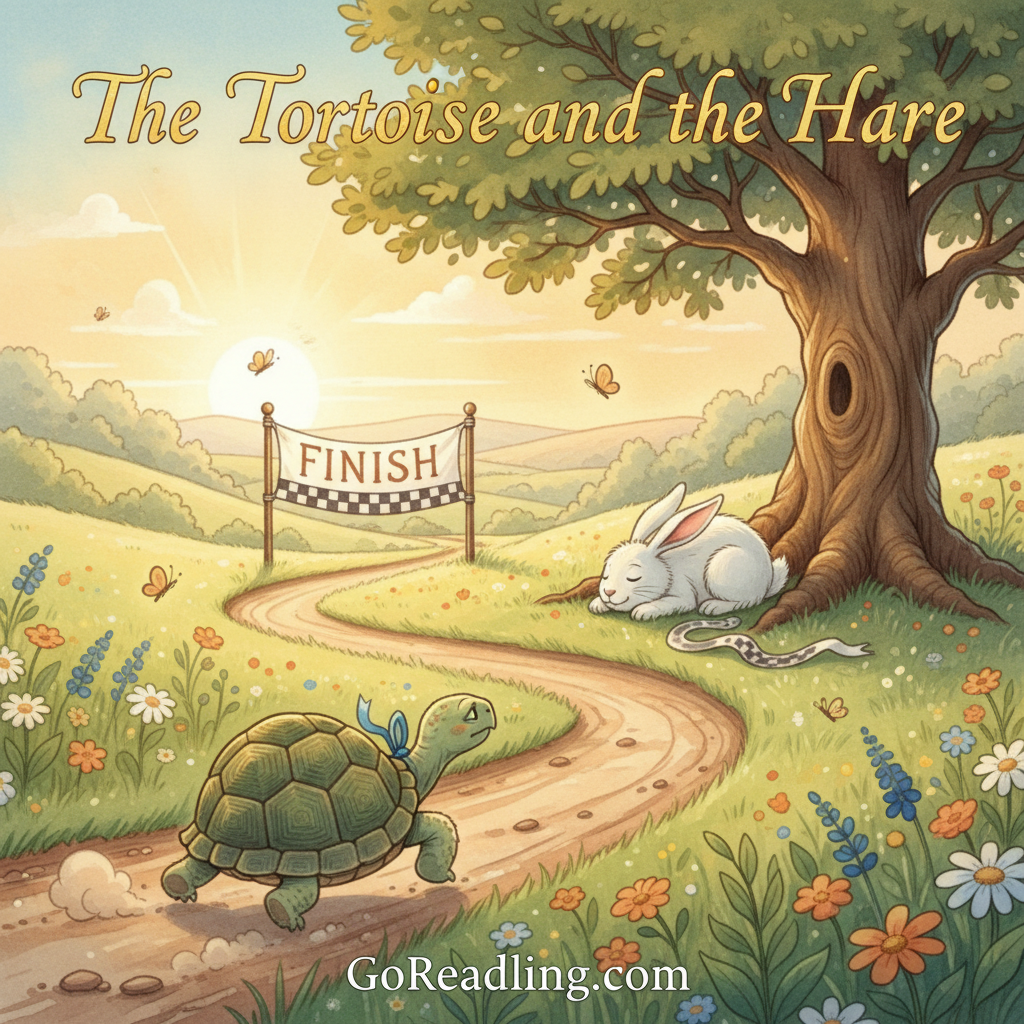
Hartley reached the stream in less than a minute. He leaped over it in a single bound, sailing through the air, his ears streaming behind him. He landed lightly on the far bank and looked back. Tilly was a tiny speck in the distance, barely past the starting line. Hartley laughed. 'This is absurd,' he said to himself. 'She will not be here for hours. Hours! I could take a nap and still win by a mile.' He looked around. The morning was warm and beautiful. The wildflowers were blooming in a riot of color, purple clover, yellow buttercups, white daisies. A patch of soft, cool grass lay in the shade of a hawthorn bush, dappled with gentle sunlight. It looked impossibly inviting. 'Just a short rest,' Hartley said, settling down into the grass. 'Five minutes. Maybe ten. She is so slow that I could sleep until noon and still beat her.' He yawned, a great, wide, luxurious yawn. He crossed his paws behind his head. The breeze was soft and warm, carrying the scent of clover and honey. His eyes grew heavy.
Within moments, Hartley was asleep. And not just a light, cautious doze, but a deep, thorough, bone-melting sleep, the kind of sleep that pulls you under like warm water and holds you there. He dreamed of racing, of course. In his dreams he ran faster than the wind, faster than light, leaping over mountains and rivers in single bounds. He dreamed he could fly. The sun climbed higher in the sky. The morning warmed into midday. Bees drifted lazily among the wildflowers. A ladybird landed on Hartley's nose, stayed for a while, and flew away. A spider began to build a web between his ears. And still he slept, snoring softly, his legs twitching now and then as he raced through his magnificent dreams. Meanwhile, far behind him, Tilly walked. Step by step by step, through the first field, her sturdy legs carrying her forward with their tireless, metronome rhythm. She reached the stream and, because she could not leap over it, she waded through the shallow water, feeling the cool current against her legs, and climbed carefully up the far bank.
Tilly walked through the patch of wildflowers, and she took a moment, just a brief moment, to admire the small blue flowers that grew among the taller ones. She noticed a caterpillar on a stem of clover and wished it a good morning. She passed the sleeping Hartley and glanced at him with her calm, dark eyes. The spider had made considerable progress on its web between his ears. A daisy had grown up through his crossed paws. He was snoring with a deep, rhythmic rumble that made the grass around his nose flutter. Tilly did not stop. She did not gloat. She did not even smile, exactly. She simply noted his position, turned her gaze back to the distant hilltop, and kept walking. One step. Another step. Another. The sun moved slowly across the sky, and Tilly moved slowly across the meadow, and neither of them hurried, and neither of them stopped. She passed the old oak tree. The animals who had gathered there watched her with wide, astonished eyes. Nobody said a word. The squirrel's mouth hung open.
The afternoon wore on. The shadows grew longer. Tilly was climbing the hill now, the final stretch of the course of gentle green slope that led up to the big chestnut tree. Her legs ached. The hill was steep for a creature built so close to the ground, and each step was an effort. But she did not stop. She had never stopped, not once, not for a single step, since the race began. Behind her, far below at the bottom of the meadow, Hartley slept on. A family of field mice had made a nest in the curve of his belly. The spider's web between his ears was now a magnificent construction, glistening with tiny droplets of afternoon dew. One of Hartley's back legs kicked out suddenly as he dreamed of an especially impressive leap, and the field mice scattered briefly before settling back in. The old owl, who had been watching from his branch all day with patient, knowing eyes, ruffled his feathers and turned his head toward the hilltop, where a small, determined shape was growing closer and closer to the chestnut tree.
The sun was low in the sky, painting everything in warm amber light, when Hartley woke. He yawned, stretched, and blinked lazily at the sky. 'How long was I asleep?' he wondered. The sun was much lower than he remembered. 'No matter,' he said cheerfully, shaking the spider's web from his ears and dislodging a startled ladybird from his shoulder. 'Tilly is probably still at the starting line.' He stood up, stretched his legs, and looked up the hill toward the chestnut tree. What he saw made his blood turn to ice. A small, round shape was moving slowly, so slowly, up the final stretch of the hill. It was close to the top. It was very close to the top. It was Tilly, and she was barely twenty paces from the finish line. Hartley's heart dropped into his stomach. 'No!' he gasped. 'No, no, no!' He launched himself forward with every ounce of speed his powerful legs possessed, his paws tearing at the ground, his ears flat against his head, a streak of desperate tawny fur blazing up the hillside.
He ran as he had never run before. He ran with his whole body, every muscle straining, every sinew stretched to its limit. He crossed the wildflower field in seconds. He flew over the stream without breaking stride. He pounded past the old oak, his lungs burning, his legs screaming. The animals along the route gasped and cheered and pressed back to let the blur of fur fly past. Up the hill he raced, his powerful legs churning, the ground a green blur beneath him. He could see Tilly ahead, ten paces from the chestnut tree, then eight, then five. He was gaining, he was closing, he was almost there. The crowd on the hilltop was shouting, the birds were screaming, the squirrels were chattering. Tilly's old legs moved with the same steady, unhurried rhythm they had maintained all day. One step. Another. Another. The chestnut tree's shadow fell across her shell.
Tilly's right front foot touched the root of the chestnut tree just as Hartley's outstretched paw reached for the trunk, two lengths behind her. She had won. The meadow erupted. Birds burst from the branches, singing. Rabbits thumped the ground with their back feet in wild applause. The squirrel did a somersault on his branch. Even the old owl, who was rarely moved to strong emotion, let out a long, approving hoot. Tilly stood quietly at the base of the chestnut tree, breathing slowly, her old heart beating its steady, faithful beat, and she looked out over the meadow, golden in the evening light, and smiled. It was a small, private smile, not triumphant, not boastful, just quietly, deeply satisfied. Hartley lay on the ground beside her, panting, his sides heaving, unable to speak. He stared at the tortoise who had just beaten him in a race, and he could not understand it. How? How had the slowest creature in the meadow beaten the fastest?
When Hartley caught his breath, he sat up and looked at Tilly. He expected to find her gloating, or smug, or at least a little pleased with herself in the insufferable way that he himself was always pleased with himself. But Tilly just looked at him with her calm, kind, ancient eyes, and there was something in her gaze that was not mockery or triumph but something gentler: understanding. 'How?' Hartley asked, and his voice was small, like a child's. 'How did you beat me?' Tilly was quiet for a moment. 'I did not beat you, Hartley,' she said. 'You beat yourself. You had every gift you needed to win this race. You are faster, stronger, more powerful than I will ever be. But you stopped. You sat down. You fell asleep. You trusted that you would win because you have always won, and you forgot the one thing that matters more than speed.' 'What is that?' Hartley asked. 'Showing up,' Tilly said simply. 'Putting one foot in front of the other and not stopping until you reach where you are going.'
Hartley was quiet for a long time. The sun was setting now, and the sky was streaked with orange and pink and purple, like a painting done by someone who loved color more than anything. The other animals had drifted away, giving them space, sensing that something important was happening. 'I have been foolish,' Hartley said at last. 'Very foolish,' Tilly agreed pleasantly. Hartley looked at her and, for the first time since she had known him, he laughed at himself. It was not the braying, boastful laugh the meadow was used to hearing. It was a quiet, rueful laugh, the sound of someone who has learned something true about himself and is surprised to find that the truth, though humbling, is also a relief. 'Will you teach me?' Hartley asked. 'Teach you what?' 'How to be steady. How to keep going. How to notice the small things instead of always racing past them.' Tilly smiled. 'I will walk with you tomorrow morning,' she said. 'We will start slowly.' 'Slowly,' Hartley repeated, and the word felt strange and new in his mouth, like a taste he had never tried before.
The next morning, Hartley was at Tilly's mossy bank by the stream at sunrise. He bounced on his enormous feet, energy crackling through every muscle in his body. 'Ready?' he asked. 'Ready,' Tilly said, and began to walk. For the first ten minutes, Hartley thought he might explode. Walking at Tilly's pace was agony for a creature built for speed. His legs twitched. His muscles screamed. Every instinct in his body told him to run, to sprint, to burst forward and leave this plodding, maddening slowness behind. But he gritted his teeth and matched her pace, one careful step at a time. And after a while, something strange began to happen. He noticed the dew on the grass, each droplet a tiny crystal ball reflecting the morning sky. He noticed the smell of the earth, rich and dark and alive. He heard the individual voices of the birds, not as a general chorus but as distinct songs, each one different, each one beautiful. He saw the tiny blue flowers between the stones that Tilly had been looking at for years. 'Oh,' he said softly. 'These are lovely.' Tilly nodded. 'They have always been there,' she said.
Days turned into weeks, and the meadow witnessed something none of its inhabitants had expected: a friendship between the fastest creature and the slowest. Every morning, Hartley and Tilly walked the meadow paths together. Hartley learned to slow down, to look, to listen, to be present in each moment instead of racing past it. He learned that a walk could be as satisfying as a sprint, that arriving was not always the point, that sometimes the journey itself was the treasure. And Tilly, in her quiet way, learned something too. She learned that it was all right to be a little bit more adventurous, to take a slightly different path, to explore a corner of the meadow she had never visited before. With Hartley beside her, she felt braver, more willing to step outside her familiar routines. They balanced each other, the hare and the tortoise, speed and steadiness, impulse and patience, and together they were better than either had been alone.
Hartley did not stop racing. He still loved to run, and he was still the fastest animal in the meadow by a wide margin. But he raced differently now. He raced for the joy of running, not for the pleasure of winning. He raced to feel the wind in his fur and the ground flying beneath his feet, not to prove that he was better than everyone else. And when he won, which he nearly always did, he was gracious and kind, complimenting his opponents on their effort rather than boasting about his own. The other animals noticed the change immediately. They began to like Hartley, which surprised them almost as much as the race itself had. He was pleasant company now, the kind of friend who listened when you talked and remembered what you said. He helped the young rabbits practice their running, patient and encouraging. He brought wildflowers to the old hedgehog, who could no longer walk far enough to find them herself. The meadow was a warmer place with this new, gentler Hartley in it.
One evening, as summer turned to autumn and the chestnut tree on the hill was heavy with glossy brown conkers, Hartley and Tilly sat together on the mossy bank by the stream. The air was cool and smelled of fallen leaves and rain and the particular, bittersweet scent of a season ending. The stream murmured its eternal, unhurried song over the smooth stones. A single leaf, red as a ruby, drifted down from a branch above and landed on the water, spinning slowly as the current carried it away. 'Tilly,' Hartley said thoughtfully, 'why did you challenge me to that race? You could have just let me keep being foolish. It was nothing to do with you.' Tilly considered this for a long time, the way she considered everything, slowly, thoroughly, and with great care. 'Because,' she said at last, 'I could see that you were lonely, Hartley. All that boasting, all that showing off, it was keeping everyone at a distance. You had won every race in the meadow, but you had not made a single friend. I thought perhaps if you lost just once, you might find something better than winning.'
Hartley blinked. His nose twitched. He looked at Tilly's wrinkled, patient face, and he felt something warm and large swell in his chest, gratitude so deep it was almost overwhelming. 'You were right,' he said quietly. 'Losing that race was the best thing that ever happened to me.' They sat in comfortable silence as the stars came out, one by one, like tiny lanterns being lit across the velvet sky. The meadow settled into its nighttime hush. The rabbits were in their burrows. The birds were on their branches. The old owl was just waking up, blinking his great round eyes at the rising moon. And on the mossy bank by the stream, the fastest creature in the meadow and the slowest creature in the meadow sat side by side, watching the sky, saying nothing, needing nothing, two friends who had found in each other exactly what they had been missing all along.
And that, dear little one, is the story of the Tortoise and the Hare. It is a very old story, one of the oldest in the world, but its truth is as fresh and bright as a spring morning. It does not matter how fast you are or how slow. It does not matter if you are the quickest or the cleverest or the strongest. What matters is that you keep going, one step at a time, steady and sure, and that you never, ever give up. The race is not always won by the swift. Sometimes it is won by the one who simply refuses to stop. So close your eyes now, little one, and rest. Tomorrow is a new day, full of new paths to walk and new things to notice. Take your time. There is no rush. The world will wait for you, and every step you take, no matter how small, is carrying you exactly where you need to go. Goodnight, dear one. Sleep well, and dream of green meadows and gentle streams and a world that rewards the patient heart.