 📖 Read & Listen Free
Once upon a time, in a prosperous kingdom where the mountains touched the clouds and the rivers ran clear as crystal, there lived a prince named Frederick. He was a young man of twenty-three, tall and fair-haired, with thoughtful gray eyes and a gentle manner that endeared him to everyone who knew him. Frederick was the only son of King Henrik and Queen Ingrid, and they loved him dearly, but they were also very concerned, because Frederick showed no inclination whatsoever to get married. It was not that he did not want to marry. He did. He wanted very much to find someone to share his life with, someone who understood him, someone who could see past the crown and the castle and the ceremony and find the real person underneath. The problem was that Frederick had very particular ideas about what made a true princess, and so far, no one he had met had quite measured up.
King Henrik thought the whole thing was perfectly simple. 'A princess is a princess,' he would say, buttering his toast at breakfast with the confidence of a man who has never had to think very deeply about anything. 'She wears a crown, she comes from a royal family, she knows which fork to use at dinner. What more do you need?' Queen Ingrid, who was considerably more perceptive than her husband, understood that Frederick was looking for something that could not be measured by crowns or bloodlines or silverware etiquette. He was looking for authenticity, for a heart that was genuine, for someone who felt things deeply and truly. She worried about her son, but she also trusted him, because she had raised him to know his own mind, and a mother who teaches her child to think for himself cannot complain when he does exactly that.
So Frederick set out to find a true princess. He traveled to every kingdom in the known world, and he met princesses of every description. He met Princess Astrid of the Northern Mountains, who could speak six languages and play the harp and recite poetry that would make you weep, but who never seemed to say anything that was actually her own, every word borrowed from a book or a tutor. He met Princess Beatrice of the Eastern Shores, who was so beautiful that courtiers literally walked into pillars when she entered a room, but who was so carefully polished and perfected that she seemed less like a person and more like a painting, lovely to look at but impossible to truly know. He met Princess Charlotte of the Western Isles, who was witty and sharp and enormously entertaining, but whose cleverness was a kind of armor, a way of keeping people at a distance.
He met dozens more. He met princesses who were kind but boring, princesses who were interesting but unkind, princesses who were perfect on paper but somehow wrong in person, like a song played in the right notes but the wrong key. He met one princess who seemed almost right, Princess Diana of the Southern Plains, who had freckles and a loud laugh and strong opinions about everything, but when Frederick looked into her eyes he saw ambition rather than warmth, calculation rather than connection, and he knew, with a certainty that made him sad, that she was performing the role of a genuine person rather than actually being one. After two years of traveling, Frederick came home, lonely and discouraged, and sat in his room in the castle and stared out the window at the rain.
Queen Ingrid found him there one evening, sitting in the dark without a candle, watching the raindrops chase each other down the glass. She sat beside him and did not speak for a long time, because Queen Ingrid understood that sometimes the most loving thing you can do for someone is simply sit with them in their sadness without trying to fix it. Finally, Frederick said, very quietly, 'Perhaps I am asking for something that does not exist.' Ingrid considered this. 'Or perhaps,' she said, smoothing the blanket on his bed with her careful hands, 'what you are looking for is not the sort of thing that can be found by searching. Perhaps it is the sort of thing that arrives on its own, unexpectedly, when you have stopped looking.' Frederick sighed. 'That sounds like something from a story, Mother.' Ingrid smiled. 'The best things usually do.'
So Frederick tried to stop looking. He threw himself into the daily life of the castle with an energy that surprised everyone, even himself. He reorganized the royal library, sorting every book by subject and language and writing a proper catalog with his own hand, a task that took three weeks and left him with ink-stained fingers and an intimate knowledge of every volume in the collection. He learned to paint watercolors, sitting in the castle garden on mild afternoons with an easel and a set of pigments, capturing the mountains in their different moods, purple and misty at dawn, golden and sharp at midday, rose and amber in the fading light of evening. He took up cooking, to the bewilderment of the kitchen staff, who had never seen a prince chop onions or knead bread or argue passionately about the proper temperature for roasting a chicken. He was not trying to forget his loneliness. He was trying to fill the space it left, and while the space never quite closed, the things he put in it were good and real and worthwhile, and they made him a more interesting person than he had been before, which is often the way these things work.
He also spent time with the people of the kingdom in a way that no prince before him ever had. He visited the farms and the workshops and the markets, not as a dignitary making an official appearance but as a curious young man who genuinely wanted to understand how bread was baked and horseshoes were forged and wool was spun and cheese was aged. He sat in cottage kitchens and drank tea with elderly grandmothers who told him stories about the old days, and he played with children in village squares and learned their games and their songs, and he asked questions, endless questions, about everything, because Frederick understood instinctively that the world is infinitely more interesting than most people bother to notice, and the people who live in it are infinitely more complex. The villagers grew to love him, not because he was a prince but because he was Frederick, and being Frederick, they discovered, was a very fine thing to be.
Several weeks later, on a night when the autumn storms had turned the sky black and the rain was falling so hard it sounded like gravel being thrown against the windows, there was a knock at the castle gate. The gatekeeper, a stout man named Otto who had been half asleep in his chair by the fire, opened the gate and found a young woman standing in the downpour. She was thoroughly, spectacularly, impossibly soaked. Water streamed from her hair, which was dark and plastered flat against her head. Her clothes were muddy and torn. Her shoes squelched with every step. She was shivering so violently that her teeth chattered like castanets, and there was a leaf stuck to her forehead that she either had not noticed or did not care about.
'Good evening,' said the young woman, through chattering teeth. 'I am terribly sorry to disturb you at this hour, but I seem to have gotten rather lost in the storm, and I was wondering if there might be any possibility of shelter for the night. I am a princess, by the way, though I realize I do not look much like one at the moment.' She said this last part with a rueful half-smile, as if she found her own bedraggled state genuinely amusing rather than embarrassing. Otto looked at her doubtfully. She did not look like a princess. She looked like something the cat had dragged in, rejected, and then dragged in again. But it was a terrible night, and the kingdom had firm rules about hospitality, so he brought her inside and sent word to the royal family.
Queen Ingrid came down to the entrance hall to meet the visitor, and she found the young woman standing in a spreading puddle of rainwater, wringing out her hair with both hands and apologizing profusely for the mess she was making on the marble floor. 'I am so sorry,' the young woman said, 'this is extremely undignified, I had a horse and a proper travel cloak and a packed lunch and everything was going splendidly until about four hours ago when the horse decided she had had quite enough of the rain and threw me into a ditch and galloped off in the direction of the nearest stable, which I cannot honestly blame her for because honestly staying in a stable seems like much the sensible option in this weather.' She paused for breath and smiled at the queen, a wide, open, unguarded smile that had absolutely nothing strategic about it.
The young woman introduced herself as Princess Marguerite, from a small kingdom several days' ride to the south. She had been traveling to visit her aunt in the north when the storm had caught her. Ingrid studied her carefully. She was not beautiful in the conventional, polished way that most princesses cultivated. Her face was expressive and mobile, quick to smile, quick to frown, quick to show exactly what she was feeling without any apparent attempt to hide it. Her eyes were dark and bright and full of intelligence and humor, and there was something about the way she carried herself, even soaking wet and covered in mud, that suggested a person entirely comfortable in her own skin. Ingrid felt a small spark of interest. 'You must be exhausted,' she said. 'Let me have a room prepared for you.'
While dry clothes were being found, Ingrid brought Marguerite to the kitchen and sat her down by the great iron stove, where the cook, a round, motherly woman named Hilda, immediately began fussing over her as if she were a half-drowned kitten. Marguerite accepted a bowl of hot soup and a thick slice of bread with butter and ate with the unselfconscious enthusiasm of someone who is genuinely hungry and sees no reason to pretend otherwise. Between spoonfuls, she talked. She talked about her journey, about the storm, about the landscape she had passed through and the people she had met along the way, a shepherd who had given her directions and a cup of warm milk, a family of otters she had watched playing in a stream for twenty minutes because she could not bring herself to leave, a peculiar cloud formation that had looked exactly like a teapot. She noticed things. She paid attention to the world in a way that was neither calculated nor performative but simply genuine, the natural habit of a mind that finds everything interesting and sees beauty in the most unexpected places.
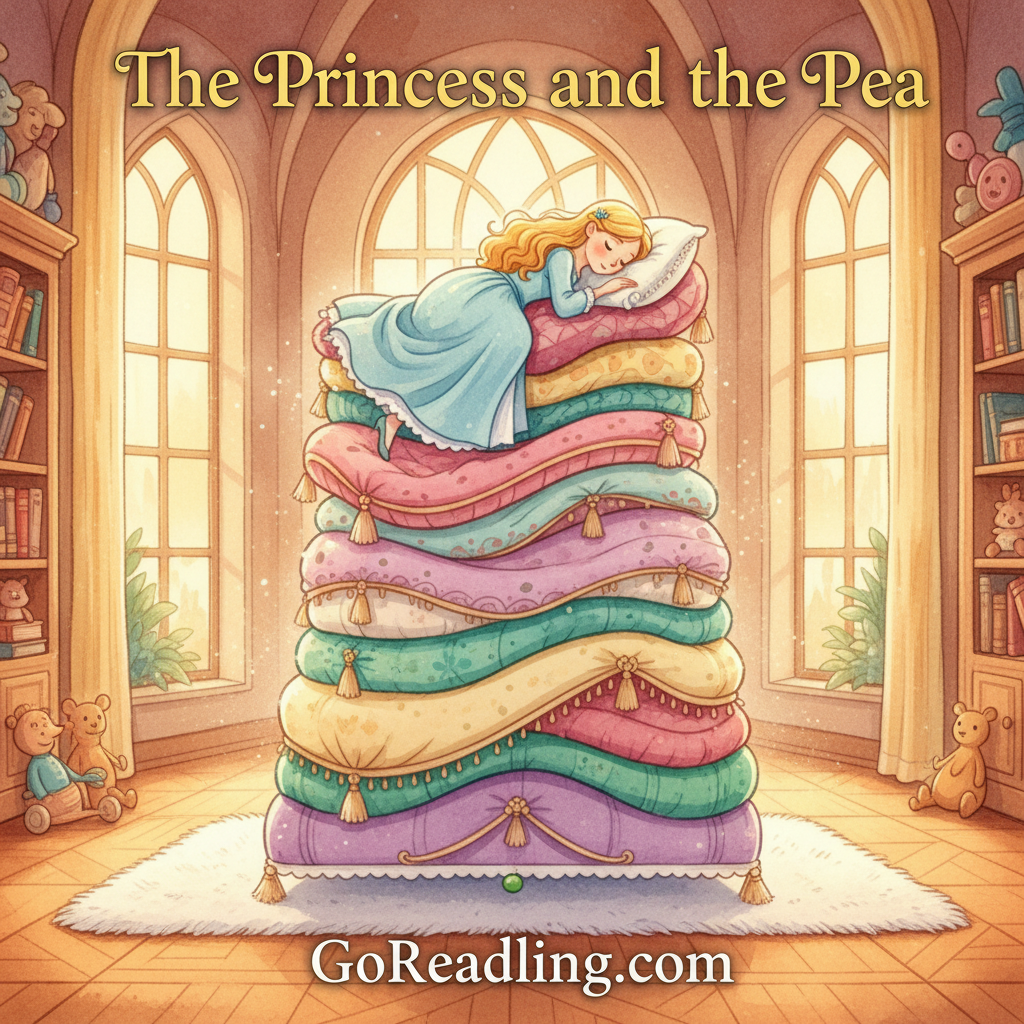
But first, Ingrid had a plan. While Marguerite was being given dry clothes and hot soup in the kitchen, Ingrid went to one of the castle's many spare bedrooms and began to prepare a very particular kind of bed. She started by placing a single dried pea on the bare wooden bedstead. Just one pea, small and hard and round, no bigger than the tip of her little finger. Then she ordered the servants to pile twenty mattresses on top of the pea, one on top of another, until the bed was so ridiculously, absurdly, comically tall that you needed a ladder to climb into it. And on top of the twenty mattresses, she placed twenty feather quilts, each one soft as a cloud and thick as a loaf of bread. The resulting bed was a towering monument to excess, a wobbling, swaying column of bedding that nearly touched the ceiling.
The servants looked at each other in bewilderment, but they had learned long ago not to question Queen Ingrid's methods. The queen herself stood back and surveyed her handiwork with a small, satisfied nod. This was an old test, a very old test, passed down through generations of queens who understood that true sensitivity, the kind of sensitivity that marks a person who feels the world deeply and genuinely, cannot be faked. A true princess, the old stories said, would feel a pea through twenty mattresses and twenty quilts. It sounded absurd. It was absurd. But Ingrid had learned that the most important truths often hide inside the most absurd-sounding stories, like seeds inside ridiculous, spiky fruits.
Marguerite was shown to her room, and when she saw the bed, her eyes went wide. 'Good heavens,' she said, staring up at the towering stack of mattresses. 'That is either the most comfortable bed in the world or a very elaborate practical joke.' The servant who had shown her in merely curtsied and left, and Marguerite stood alone in the room, looking up at the bed with an expression of amused bewilderment. She found the ladder, climbed up, and settled in among the twenty feather quilts. The bed was extraordinarily soft. It was like lying on a warm, gentle cloud. But almost immediately, Marguerite felt something. A small, hard, persistent pressure somewhere far below her, pressing up through all those layers of mattress and quilt, a tiny discomfort that she could not ignore no matter how she shifted and turned.
She tried lying on her back. She could feel it. She tried lying on her side. She could still feel it. She tried lying on her stomach, diagonally, curled into a ball, spread out like a starfish, and every single position she tried, there it was, that tiny, maddening, inexplicable pressure, like a pebble in a shoe or a crumb in a bed or a whisper in a quiet room that you cannot quite make out but cannot quite ignore. Marguerite was not the sort of person who complained. She had traveled rough roads and slept in barns and once spent a night in a tree to avoid a pack of wolves. She was tough and practical and resilient. But this tiny, impossible, persistent discomfort beneath forty layers of bedding was slowly, methodically driving her out of her mind.
She got up and looked under the bottom mattress but could see nothing in the darkness beneath the bed frame. She lay down again and tried counting sheep, which did not work because the sheep kept lying down on the uncomfortable spot and getting up again. She tried reciting the kings and queens of every kingdom she knew, in chronological order, which usually put her to sleep within minutes, but tonight her mind kept circling back to the lump, the bump, the inexplicable hard thing far below her. She tossed and turned and punched her pillow and rearranged her quilts and stared at the ceiling and listened to the storm raging outside and thought longingly of the ditch she had been thrown into earlier, which, while muddy and cold, had at least been relatively flat.
Morning came at last, gray and drizzly, and Marguerite climbed stiffly down the ladder and made her way to the breakfast room, where King Henrik, Queen Ingrid, and Prince Frederick were already seated. She looked dreadful. Her eyes were ringed with dark circles, her hair was sticking up at odd angles, and she had the slightly wild, unhinged look of a person who has spent the entire night wrestling with invisible forces. Frederick, who had been told about the visitor but had not yet met her, looked up from his porridge and felt something shift in his chest, a small, unexpected rearrangement of his heart, like a key turning in a lock he had forgotten was there.
'Good morning,' said Queen Ingrid, with a carefully neutral expression. 'I trust you slept well?' Marguerite opened her mouth, clearly intending to say something polite and gracious, and then closed it again. She looked at the queen. She looked at the king. She looked at the prince, who was watching her with an expression of curious interest. And then she said, with the honest, unfiltered directness of a woman who has been awake all night and has completely run out of polite, 'Your Majesty, I do not wish to seem ungrateful, because your hospitality has been extraordinary and the bed was clearly assembled with great care and expense, but I must tell you honestly that I did not sleep a single wink. There was something hard in that bed, some lump or bump or stone or something, buried way beneath all those mattresses, and it poked me and prodded me all night long until I am black and blue from head to toe.'
There was a silence. King Henrik looked confused. Frederick's spoon had stopped halfway to his mouth. And Queen Ingrid smiled. It was a small, quiet, deeply satisfied smile, the smile of a scientist whose experiment has produced exactly the result she predicted. 'My dear,' she said, reaching across the table to pat Marguerite's hand, 'I believe I owe you an explanation, and an apology.' And she told her about the pea. About the test. About the old tradition, and what it meant, and why she had done it. Marguerite listened with widening eyes, and when Ingrid had finished, she was quiet for a moment, and then she laughed. It was a real laugh, genuine and warm and full-throated, the laugh of a person who finds the world genuinely funny and does not mind being the joke.
'A pea!' she exclaimed, shaking her head in disbelief. 'One pea, under all of that? That is the most ridiculous and wonderful thing I have ever heard. I thought I was going mad! I thought there was some sort of enchantment on the bed, or that I was getting ill, or that I had somehow become the most unreasonably fussy person in the entire kingdom!' She laughed again, and Frederick laughed with her, and even King Henrik, who still did not entirely understand what was happening, chuckled along, because Marguerite's laughter was infectious, the kind of laughter that fills a room like sunlight and makes everything brighter and warmer and more alive. Queen Ingrid watched them all with her quiet, knowing smile.
Frederick and Marguerite spent the rest of the day together, walking through the castle gardens despite the drizzle, talking about everything and nothing. Frederick discovered that Marguerite was funny and clever and opinionated and kind, that she loved horses and hated embroidery, that she could identify every wildflower in the meadow by its proper name, and that she had strong feelings about the proper way to make soup, which, she informed him seriously, involved a great deal more garlic than most people were willing to admit. Marguerite discovered that Frederick was thoughtful and gentle and surprisingly witty, that he loved music and architecture and the way the light changed in the mountains at different times of day, and that beneath his quiet, princely exterior there was a person of deep feeling and genuine warmth who had simply been waiting for someone real enough to open up to.
They walked through the rose garden, where the last roses of autumn were clinging stubbornly to their branches, their petals bright with rain. They walked along the castle walls, looking out over the misty valley below. They sat in the library and Frederick played the piano while Marguerite sat in the window seat and listened, and when he played a piece that was particularly beautiful, she did not applaud or compliment him politely or say any of the correct, expected things. She simply sat very still for a moment, and then she said, quietly, 'That one made me want to cry.' And Frederick knew, with a certainty as solid and simple as a stone, that he had found what he had been looking for.
That evening, they dined together, all four of them, in the small dining room rather than the grand hall, because Marguerite said she preferred rooms where you could actually hear the person across the table without shouting. She told stories about her own kingdom, about the strawberry festival they held every summer where the entire village turned pink with juice, about her father who kept bees and talked to them as if they were old friends, about her three younger sisters who were each more trouble than the last and whom she adored with a ferocity that made her voice go soft and warm whenever she mentioned them. She asked King Henrik about his hunting, and he talked for twenty minutes about a stag he had once tracked through the mountains, and Marguerite listened with genuine interest and asked exactly the right questions and did not once look bored, because she was not bored, because she was the kind of person who could find the interesting thread in any story if she pulled gently enough. Frederick watched her across the table and thought that this was exactly what he had been looking for all along, not perfection, not beauty, not breeding, but this, this warmth, this realness, this ability to make a room feel like home simply by being in it.
The courtship was not accomplished overnight. Marguerite went home to her own kingdom and Frederick visited her there, and they wrote long letters to each other, letters full of jokes and questions and small observations about the world, the kind of letters that make you smile before you have even opened the envelope because you know who they are from. The wedding took place the following spring, in the castle chapel, with wildflowers and candles and Marguerite's terrible horse, who had been recovered from a farmer's stable thirty miles away and stood outside the chapel window looking thoroughly unrepentant. Marguerite wore a simple dress of pale blue silk and a crown of daisies, and Frederick wore an expression of such uncomplicated happiness that his mother had to dab her eyes with her handkerchief throughout the entire ceremony.
Queen Ingrid had the famous pea mounted in a tiny crystal case and placed in the royal museum, where it can be seen to this day, or so the story goes, a small, ordinary, wrinkled pea sitting on a velvet cushion under glass, and next to it a little placard that reads, 'The Pea That Found a Princess.' It became the most popular exhibit in the whole museum. People would stand in front of it and laugh, because it was funny, this tiny, insignificant thing that had changed the course of a kingdom, and they would shake their heads in wonder at the idea that something so small could matter so much. But the truth is that small things always matter. A kind word. A genuine laugh. A single honest moment in a world full of performance and pretense.
Frederick and Marguerite were happy together. Not the vague, dreamy, fairytale happiness that exists only in stories, but the real, complicated, day-to-day happiness that comes from choosing each other, over and over, in the small moments as well as the grand ones. They argued sometimes, because honest people always do, but they argued well, with respect and humor and a shared commitment to understanding rather than winning. Marguerite brought warmth and energy and a refreshing lack of ceremony to the castle. She insisted on opening the great doors on market days so that anyone could come in and see the gardens. She started a school in the village for children who could not afford tutors. She planted a kitchen garden behind the castle and grew vegetables and gave them to anyone who needed them.
Frederick, inspired by Marguerite's example, became a better prince and eventually a better king than anyone had expected. He listened to his people, really listened, the way he had listened to Marguerite that first rainy morning at breakfast, and he made decisions not based on tradition or convenience but on what was actually right, even when what was right was not easy. They had three children, two girls and a boy, all of them with their mother's expressive eyes and their father's quiet thoughtfulness, and Queen Ingrid lived long enough to see them all grow up and was thoroughly satisfied with every single one of them, even the youngest, who put a live frog in the soup tureen at a state dinner, because Ingrid recognized in that act the same spirit of genuine, irrepressible mischief that she had seen in Marguerite's eyes on that stormy night so many years ago.
And that, dear little one, is the story of the Princess and the Pea. It is a story about small things that matter, about the importance of being genuine in a world that sometimes rewards pretending, about how the people who feel things most deeply are often the ones who look the least impressive on the outside, soaked with rain and covered in mud and not at all what you expected. Remember, as you snuggle down into your own cozy bed tonight, that it is perfectly all right to be sensitive. It is all right to feel things strongly. It is all right to notice the pea under the mattress when everyone else says there is nothing there. That sensitivity is not a weakness. It is a superpower. It means you feel the world more fully and more truly than most people ever will, and that, my darling, is a gift worth treasuring. Goodnight, little one. Sleep tight. And if you feel a lump under your mattress tonight, well, you know what that means.