 📖 Read & Listen Free
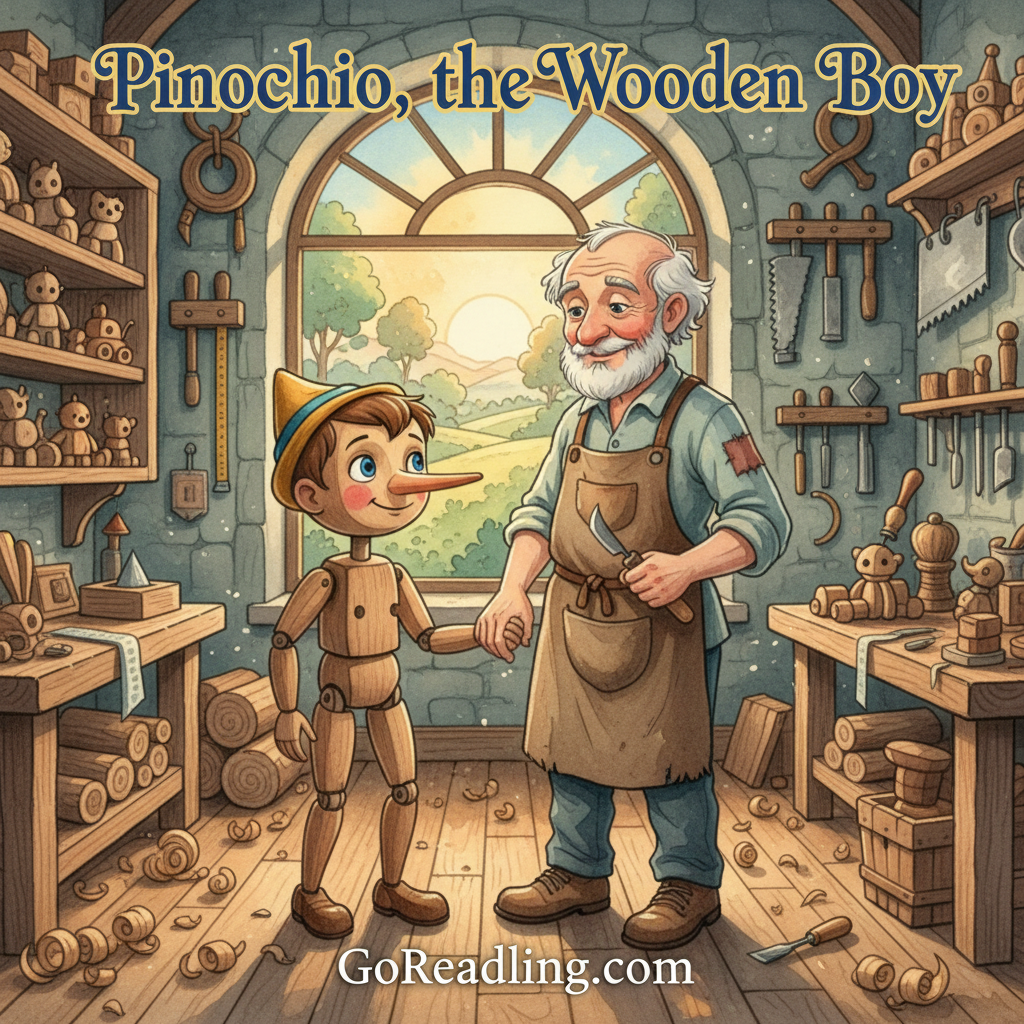
Once upon a time, in a narrow cobblestone street in a small Italian village, there was a workshop filled with the smell of fresh wood shavings and linseed oil. The workshop belonged to an old carpenter named Geppetto. He was a kind and gentle man with white hair that curled around his ears like tiny clouds, a long nose that turned pink in the cold, and hands that were rough and scarred from a lifetime of working with wood but could carve the most delicate, beautiful things you have ever seen. Geppetto could make anything from wood, chairs and tables and cabinets, of course, but also wonderful toys: tiny dancing bears with jointed legs, sailing ships with real cloth sails, music boxes with ballerinas that twirled when you opened the lid. Children pressed their faces against his window to watch him work, and he always smiled and waved at them, sawdust in his eyebrows and a chisel behind his ear. But Geppetto lived alone. He had no wife, no children, no family at all. His only companions were a fat orange cat named Figaro and a small cricket who lived behind the stove and chirped gentle songs on cold evenings.
One evening, as the autumn rain tapped softly against the workshop windows and the fire in the stove crackled warmly, Geppetto sat at his workbench with a very special piece of wood in his hands. It was a piece of pine, smooth and pale and wonderfully shaped, and it had been sitting on his shelf for months, waiting for the right project. Tonight, Geppetto knew what he would make. He picked up his finest carving tools, the small ones with the razor-sharp blades that could shape a curve smoother than silk, and he began to carve. He carved two legs, sturdy and straight, with tiny round knees. He carved two arms, jointed at the elbows and wrists, with little hands that had five perfect fingers each. He carved a round body and narrow shoulders and a neck that could turn. And last, with the greatest care, he carved a head: a round face with wide eyes, a small upturned nose, a smiling mouth, and a chin with a tiny dimple. He sanded every surface until it was as smooth as glass. He painted the face with careful brushstrokes, rosy cheeks, bright blue eyes, a cheerful red mouth. When he was finished, he held the puppet up and looked at it, and something in his old heart ached with a tender, familiar loneliness.
'I wish you were real,' Geppetto whispered to the puppet. 'If you were real, I would call you Pinocchio, and you would be my son, and this old workshop would not be so quiet anymore.' He set the puppet carefully on the workbench, said goodnight to Figaro and the cricket, and went upstairs to bed. The rain continued to fall. The fire burned low in the stove, its embers glowing orange in the dark workshop. The cricket chirped softly from his spot behind the warm bricks. And then something happened that had never happened before and would never happen again, not in that workshop, not in that village, not anywhere in the ordinary world. A blue light appeared. It drifted through the workshop like a firefly, but larger and brighter, pulsing gently with a warm, living glow. It hovered over the puppet on the workbench, and the light grew stronger, filling the room with a soft blue radiance that made the wood shavings on the floor look like scattered gold. The cricket stopped chirping and watched with wide, astonished eyes.
The blue light touched the puppet, and a warmth spread through the smooth pine wood, a warmth like sunlight, like a heartbeat, like the first breath of spring after a long, cold winter. The puppet's painted eyes blinked. Its carved fingers twitched. Its little wooden mouth opened, and a sound came out, not a creak or a click, but a voice, high and clear and new, like a bell being rung for the first time. 'Oh!' said the puppet, looking around the workshop with enormous, wondering eyes. 'Oh! Where am I? What is this place? What am I?' He sat up on the workbench, his jointed legs swinging, and he looked down at his wooden hands and turned them over and over, marveling at the way his fingers moved. He poked his own nose. He touched his own ears. He wiggled each individual toe. Everything was new, everything was astonishing, everything was wonderful. The cricket, who was old and wise and had seen many strange things in his long life behind the stove, hopped up onto the workbench and cleared his tiny throat. 'You,' said the cricket, 'are a puppet who has been brought to life. And that old man upstairs is your father.'
Pinocchio clambered down from the workbench, his wooden legs clacking against the floor, and he began to explore the workshop with the frantic, chaotic energy of a creature experiencing everything for the first time. He knocked over a jar of brushes. He stepped in a pot of paint and left blue footprints across the floor. He pulled open drawers and scattered nails and screws everywhere. He tried to pick up Figaro, who hissed and fled under the stove. He discovered a mirror and spent five minutes making faces at himself, delighted by the way his carved features moved. 'I am alive!' he shouted, dancing around the workshop in a clumsy, clattering jig. 'I am alive, I am alive, I am alive!' The cricket watched from the workbench with a mixture of fondness and concern. 'Yes, you are alive,' the cricket said carefully. 'And being alive comes with responsibilities. You must be good. You must be honest. You must listen to your father and go to school and learn to be a proper boy.' Pinocchio stopped dancing and looked at the cricket. 'School?' he said. 'What is school?'
The next morning, when Geppetto came downstairs and found his wooden puppet sitting at the kitchen table, eating an apple and chatting cheerfully with the cricket, the old man nearly fainted. He sat down heavily in his chair, his mouth opening and closing without sound, his eyes fixed on the impossible, miraculous sight of his carved creation alive and talking and spilling apple juice on the tablecloth. 'Good morning, Father!' Pinocchio said brightly. Geppetto burst into tears. He swept Pinocchio into his arms and held him close, this wooden boy, this impossible gift, this answer to a wish he had barely dared to make. 'Pinocchio,' he whispered. 'My boy. My son.' Pinocchio hugged him back, his wooden arms wrapped around the old man's neck, and for a moment the workshop was filled with a happiness so pure and so complete that even Figaro emerged from under the stove and rubbed against Geppetto's ankles, purring. The cricket watched from his spot behind the stove and noted, with some satisfaction, that the blue light had chosen well.
Geppetto sold his only warm coat to buy Pinocchio a spelling book, a satchel, and a school uniform. It was a sacrifice that Geppetto made without hesitation, though the autumn mornings were cold and his old jacket was thin. 'Education is the most important thing,' he told Pinocchio, buttoning the uniform with gentle, trembling fingers. 'If you go to school and study hard, you can become a real boy someday. A real boy with a real future.' Pinocchio looked at the spelling book, which was heavy and full of small print. He looked at the satchel, which smelled of new leather. He looked at himself in the mirror, a wooden puppet in a school uniform, and he felt a complicated mixture of excitement and reluctance. 'I will be the best student in the whole school!' he declared, because Pinocchio was the kind of person who made grand promises with complete sincerity and absolutely no idea how difficult they would be to keep. He kissed Geppetto on the cheek, slung his satchel over his shoulder, and marched out the door into the bright morning sunshine, heading toward the village school.
He did not make it to school. He got as far as the main street when he heard something that stopped him in his tracks: music. Lively, jangling, irresistible music, the sound of drums and trumpets and tambourines, rolling out of a side street like a wave of pure joy. Pinocchio turned toward the sound, his eyes wide. There, set up in the town square, was a traveling puppet theater, a great wooden stage hung with red and gold curtains, with painted scenery and tiny footlights and a crowd of children already gathering in front of it. A banner above the stage read, in letters three feet tall, THE GREAT MARIONETTE THEATER. Pinocchio stood at the edge of the crowd, mesmerized. The puppets on the stage were dancing and tumbling and fighting with tiny wooden swords, and they looked just like him, wooden bodies, painted faces, jointed limbs. But they were on strings, controlled by a puppeteer above, while he was free. 'Come in, come in!' called a large, booming man at the entrance. 'Only two coins to see the show!' Pinocchio looked at the puppet theater. He looked down the street toward the school. He looked back at the theater. The music swelled.
Pinocchio sold his spelling book for two coins and went to the show. The cricket, who had been riding in his satchel, was horrified. 'Pinocchio, no! Your father sold his coat for that book! You promised to go to school!' But Pinocchio was not listening. He was watching the puppet show with his mouth hanging open, clapping and cheering with the other children, utterly lost in the spectacle. And then something unexpected happened. The puppets on stage noticed him, a puppet who walked without strings, who clapped and laughed with the audience, who was alive. They stopped their performance and stared. The audience murmured in confusion. And the puppeteer, a huge man named Stromboli with a black beard like a thundercloud and small, shrewd, greedy eyes, peered down from behind the stage and saw Pinocchio, and a slow, calculating smile spread across his face. 'A puppet without strings,' Stromboli murmured. 'A puppet that moves on its own. That is worth a fortune.'
Stromboli invited Pinocchio backstage with honeyed words and flattery. 'You are magnificent!' he boomed, his arm around Pinocchio's wooden shoulders. 'You are unique! A living puppet! People will come from miles around to see you perform. You will be famous! You will be a star!' Pinocchio's painted eyes shone with excitement. Fame! Stardom! A theater of his own! He imagined himself on stage, dancing and bowing, the audience cheering. He imagined his name on the banner. He did not notice when Stromboli locked the door. He did not notice the bars on the windows. He did not notice the large iron cage in the corner of the wagon until Stromboli's smile turned cold and hard and his honeyed voice became a snarl. 'Get in the cage, puppet,' Stromboli said. 'You belong to me now. You will perform when I tell you to perform, and you will stay locked up when you are not on stage. If you behave, I will oil your joints twice a week. If you cause trouble, I will use you for firewood.' The door of the cage slammed shut.
Pinocchio sat in the cage, his wooden knees drawn up to his wooden chin, and for the first time since he had come to life, he felt something new and terrible: regret. He thought about Geppetto, alone in the cold workshop without even his warm coat, waiting for his son to come home from school. He thought about the spelling book he had sold for two worthless coins. He thought about the cricket's warning, which he had ignored so easily and so completely. 'I should have gone to school,' he whispered. 'I should have listened.' The cricket appeared between the bars of the cage, having followed Pinocchio with the loyal, exasperated persistence of a conscience that knows it will be ignored but refuses to give up. 'What do we do now?' Pinocchio asked miserably. 'You start,' the cricket said, 'by admitting you were wrong. And then we figure out how to get you home.' It was a long night. Through the bars of the cage, Pinocchio could see the stars, cold and bright, and he wondered if Geppetto was looking at them too.
Escape came in the small hours of the morning, when Stromboli was asleep in his tent, snoring so loudly that the wagon shook. The blue light returned, slipping through the bars of the cage like a whisper, and touched the lock, which clicked open silently. Pinocchio crept out of the cage, out of the wagon, out into the cold night, the cricket riding on his shoulder. They ran through the dark streets of the village and out into the countryside, Pinocchio's wooden feet pattering on the dirt road, the stars wheeling overhead. They ran until the puppet theater was far behind them and the only sound was the wind in the trees and the distant hooting of an owl. But instead of turning toward home, toward Geppetto and the warm workshop, Pinocchio stopped at a crossroads. 'Which way is home?' he asked. The cricket pointed left. On the right, a signpost read: THE LAND OF TOYS, FREE CANDY AND NO SCHOOL. Pinocchio looked left. He looked right. The cricket saw his expression and groaned. 'No,' the cricket said firmly. 'Absolutely not. Do not even think about it.' Pinocchio turned right.
The Land of Toys was everything it promised and nothing it should have been. It was a place where children ran wild through candy-colored streets, eating sweets until their teeth ached, playing games all day and all night, with no parents, no teachers, no rules, and no bedtime. Pinocchio joined in with abandon, gorging on cakes and toffee, sliding down chocolate hills, playing leapfrog in the town square at midnight. It was glorious. It was paradise. It was, the cricket tried repeatedly to explain, a trap. But Pinocchio would not listen. He never listened. Listening required the kind of stillness and patience that his wooden, impulsive, endlessly distracted nature simply could not sustain. The cricket shouted himself hoarse, warning of consequences and responsibility and the importance of going home, but his tiny voice was lost in the noise of a thousand children determined to have fun. And then, on the fourth morning, Pinocchio woke up and something was wrong.
His ears were longer. He touched them with his wooden fingers and felt, to his horror, that they had grown soft and fuzzy and pointed, like the ears of a donkey. He scrambled to a mirror and saw that it was true: two tall, grey, furry donkey ears sprouted from the sides of his wooden head. He screamed. He looked around and saw that the other children were changing too. Some had tails. Some had hooves where their hands and feet had been. Some were already on all fours, braying instead of speaking. The Land of Toys was not a gift. It was a curse, a place that turned children into donkeys, to be sold as beasts of burden to farms and mills and mines. The puppet master of this terrible place, a grinning man in a red coat, was already leading the transformed children into carts. Pinocchio's legs wobbled. His voice cracked. But he could still speak, still think, still move. He was wood, not flesh, and the curse that turned real boys into donkeys could not fully transform a puppet who had never been fully real. It was this imperfection, this incomplete humanity, that saved him.
Pinocchio fled the Land of Toys with the donkey ears still on his head, running through fields and forests, tripping and stumbling, the cricket clinging to his shoulder shouting directions. They ran for hours until the terrible place was far behind them. When they finally stopped, gasping, beside a stream in a quiet wood, Pinocchio looked at his reflection in the water and wept. Wooden tears, which is to say no tears at all, but the emotion was real, a deep, shuddering grief that racked his jointed body. 'Look at me,' he whispered. 'Look what I have done to myself.' The cricket, who was bruised from the ride and thoroughly irritated, softened slightly. 'The ears will fade,' he said, 'if you start making better choices. But Pinocchio, you must understand. Every choice has consequences. Every wrong turn takes you further from where you need to be. Your father is alone and worried and cold, and you are here, lost in the woods with donkey ears, because you refused to listen to anyone who tried to help you.' Pinocchio hung his wooden head. 'I want to go home,' he said. 'Then let us go home,' the cricket replied.
The journey home was long. They walked for days through forests and over hills, sleeping in haystacks and hollow trees, living on wild berries and stream water. Pinocchio's donkey ears slowly shrank, a little bit each day, as though the act of walking toward home, of choosing the right direction at last, was undoing the curse step by step. Along the way, they twice encountered trouble. The first was a fox and a cat who appeared at the roadside, charming and well-dressed, offering to show Pinocchio a field where coins grew on trees. 'Plant one gold coin and by morning you will have a tree dripping with a thousand gold coins!' the fox said smoothly, his tail swishing. Pinocchio had no gold coins and said so. 'Then come with us anyway,' the cat purred, her eyes glittering. 'We know a shortcut.' The cricket grabbed Pinocchio's ear. 'They are thieves,' the cricket hissed. 'They want to rob you. Keep walking.' And for the first time in his short, chaotic life, Pinocchio listened. He thanked the fox and cat politely and kept walking, and behind him he heard the fox curse under its breath and the cat spit with frustration.
The second time, they came to a village where a traveling showman was advertising a donkey show. 'See the amazing dancing donkeys!' the signs read. 'Formerly the children of the Land of Toys!' Pinocchio stopped and stared at the caged donkeys with their sad eyes and their heavy chains, and he recognized some of them, the boys he had played leapfrog with in the midnight square. They could not speak anymore. They could not think in words anymore. They were donkeys, fully and completely, and they would be donkeys for the rest of their lives, hauling carts and turning millstones and carrying loads until they were used up. Pinocchio stood in front of those cages for a long time, looking at what he had almost become, and something hardened inside him, a resolve, a determination that had not been there before. He was going home. He was going to find Geppetto. He was going to make things right. And he was never, ever going to take the easy path again when he knew the right path was harder.
When they finally reached the village, Pinocchio ran through the familiar streets to Geppetto's workshop. He flung open the door, his heart racing, the apology already forming on his lips. But the workshop was dark and cold and empty. The fire was out. The tools were untouched. Dust covered the workbench. Figaro sat on the windowsill, thin and mournful, and meowed when he saw Pinocchio. 'Where is my father?' Pinocchio asked, his voice breaking. A neighbor appeared in the doorway. 'You are the puppet boy,' she said. 'Your father went searching for you. Weeks ago. He built a small boat and sailed out to sea, because he heard you might have been taken by Stromboli's traveling show, which had gone to the islands. The sea took his boat. There was a storm. No one has seen him since.' Pinocchio felt the world tilt beneath his wooden feet. His father, his poor, kind, cold, coatless father, had gone looking for him. Had gone to sea in a tiny boat to find the son who had thrown away his school books and run off to puppet shows and candy lands. And now he was gone.
Pinocchio did not hesitate. He walked to the harbor, Figaro at his heels and the cricket on his shoulder, and he looked out at the sea. It was grey and vast and restless, the waves rolling endlessly toward the horizon, and somewhere out there, his father was alone. Pinocchio could not swim. He was made of wood. But wood floats, and that was enough. He waded into the cold water and began walking along the sea bottom, his wooden feet on the sandy floor, the water rising to his knees, his waist, his chest. When it rose over his head, he kept walking. The cricket, sealed in a tiny bubble of air trapped in Pinocchio's satchel, held on and kept quiet for once, understanding that nothing he could say would change what was happening. The sea was dark and strange and full of wonders: forests of waving kelp, schools of silver fish that parted around him like curtains, great crabs that clicked their claws as he passed. Pinocchio walked across the ocean floor, his painted eyes searching the murky water for any sign of a small boat, a white-haired old man, a father lost at sea.
He walked for a long time in the underwater dark. Then, ahead, he saw something enormous. It was a shape so vast that at first he thought it was a mountain, but mountains do not breathe, and this thing was breathing, slow and deep, its sides expanding and contracting with a rhythm like the tide itself. It was a whale. The biggest creature Pinocchio had ever seen or imagined, a leviathan with a mouth like the entrance to a cathedral and an eye the size of a dinner table. It hung in the water, barely moving, ancient and immense. And as Pinocchio crept closer, his wooden heart hammering in his chest, he saw something through the great creature's slightly parted jaws: a faint, flickering light. A candle. There was a candle burning inside the whale. Pinocchio knew, with a certainty that went deeper than reason, that his father was in there.
Pinocchio walked into the whale's mouth. It was like entering a cave, a warm, wet, enormous cave that smelled of salt and seaweed and the deep, ancient breath of the ocean. The whale's throat was a long, dark tunnel, and Pinocchio followed it, his wooden feet squelching on the soft, damp surface, the cricket trembling in his satchel. The candlelight grew brighter. And then the tunnel opened into a vast chamber, the whale's belly, a space the size of a church, dimly lit, with the ribs curving overhead like the arches of a great cathedral. And there, sitting on a pile of old nets and broken crates and driftwood, wrapped in a tattered blanket, his white hair longer and wilder than Pinocchio remembered, was Geppetto. The old man had survived the shipwreck by being swallowed whole. He had built a camp from the wreckage that the whale had swallowed over the years. He had a candle and a fishing line and a small fire burning on a flat piece of iron. He looked thin and pale and tired, but he was alive.
'Father!' Pinocchio cried, running across the floor of the whale's belly and throwing his wooden arms around the old man. Geppetto stared at him as though he were seeing a ghost. 'Pinocchio?' he whispered. 'Is it really you?' 'It is me, Father. I have come to take you home.' Geppetto wept. He held his wooden boy and wept into his painted hair, and the tears ran down the puppet's smooth wooden cheeks and dripped onto the old man's tattered blanket. 'I searched for you,' Geppetto said. 'The storm took my boat, and then the whale, and I have been here ever since. I thought I would never see you again.' 'I am here,' Pinocchio said. 'And I am not leaving without you.' The cricket hopped out of the satchel and onto Geppetto's knee. 'Hello, old friend,' the cricket said. 'We have had quite a journey. Now, the question is, how do we get out of a whale?'
It was Pinocchio who had the idea. He gathered every piece of dry wood and driftwood in the whale's belly and built a great fire, piling it higher and higher until the flames leaped and crackled and the smoke billowed upward into the whale's vast interior. The smoke irritated the whale. It tickled the great creature's throat. It filled its lungs with an uncomfortable, scratchy heat. The whale coughed. The whale sneezed. And then the whale opened its mouth as wide as it would go and expelled everything inside it in one enormous, explosive rush of air and water. Geppetto, Pinocchio, Figaro, the cricket, the broken crates, the fishing nets, and about a thousand gallons of seawater were launched out of the whale's mouth and into the open ocean like corks from a bottle. They tumbled through the air, through spray and mist and blue sky, and splashed into the sea.
Geppetto could not swim. He thrashed in the cold water, gasping, going under. Pinocchio grabbed him. The puppet was made of wood, and wood floats, and Pinocchio used his own body as a raft, lying flat on the water's surface while his father clung to his back. 'Hold on, Father,' Pinocchio said. 'I will get us to shore.' He paddled with his small wooden arms, kicking with his wooden legs, hour after hour, fighting the current, fighting the waves, fighting the exhaustion that was not muscular but something deeper, a weariness of the spirit, a tiredness of the will. The shore was far away, a thin grey line on the horizon. The waves pushed them back. The current dragged them sideways. But Pinocchio did not stop. He thought of every wrong turn he had taken, every lie he had told, every selfish choice that had led to this moment, and he poured his regret into his arms and legs and used it as fuel. 'I will save him,' he told himself. 'Whatever it takes. I will bring him home.'
They reached the shore at sunset. Pinocchio dragged Geppetto onto the sand and collapsed beside him, his wooden body battered and waterlogged, one arm cracked, his paint peeling, but whole. Geppetto lay on the beach, breathing, alive, the warm sand under his back and the sky above him turning rose and gold. Figaro shook himself dry and sat on Geppetto's chest, purring. The cricket climbed to the highest point of a nearby rock and watched the sun go down. Pinocchio lay on the sand and looked up at the first stars appearing in the darkening sky, and he felt something he had never felt before, a peace that went all the way through him, through his wooden body and his painted face and down into whatever strange, wonderful thing it was that the blue light had put inside him when it brought him to life. He had done something truly good. Not for applause, not for reward, not because someone told him to, but because it was right, and because the old man lying beside him on the sand was his father and he loved him.
The blue light returned one last time. It came to them on the beach as the stars blazed overhead and the waves whispered against the sand. It was warmer and brighter than before, and when it touched Pinocchio, it did not just warm him, it changed him. The wood softened. The joints disappeared. The paint faded and was replaced by real skin, warm and freckled and alive. His carved fingers became real fingers, with real nails and real knuckles. His painted eyes became real eyes, brown and bright and brimming with tears, real tears, warm and wet and rolling down cheeks that could feel them. His wooden chest cracked open and inside it a heart began to beat, a real human heart, strong and steady and brand new. Geppetto sat up and stared at his son, his real son, a real boy with real eyes and real tears and a real heart beating under a real chest, and the old man's face broke into a smile so wide and so joyful that it seemed to light up the entire beach.
'Father,' Pinocchio said, and his voice was different, softer, richer, a real boy's voice, thick with emotion. 'Father, I am real.' 'You were always real,' Geppetto whispered, pulling his son close. 'From the very first moment I carved you, you were real to me.' They walked home together through the cool night, the old carpenter and the boy who had been a puppet, with the cat at their heels and the cricket singing softly on the boy's shoulder. The village was quiet. The workshop was dark. But when Geppetto opened the door and lit the lamp and the warm yellow light filled the room, it did not feel empty anymore. It felt like home, truly and completely, for the first time. Geppetto made soup and they sat at the kitchen table and ate together, and the fire crackled in the stove, and Figaro curled up on the rug, and the cricket took his place behind the stove and began his evening song.
And that, dear little one, is the story of Pinocchio, the wooden boy who became real. It is a story about the long, winding, sometimes painful journey of learning to be good, not perfect, because nobody is perfect, but good. Good enough to listen when a wise voice offers guidance. Good enough to admit when you are wrong. Good enough to walk into the belly of a whale to save someone you love. You do not become real by being flawless. You become real by being brave and honest and kind, by making mistakes and learning from them, by loving someone enough to cross an ocean for them. So close your eyes now, little one, and let the waves carry you off to sleep. Your heart is real and it is beating, strong and warm, in your chest. And somewhere, an old carpenter is smiling, because you, just as you are, are the most wonderful thing he ever made. Goodnight, dear child. Sleep well.