 📖 Read & Listen Free
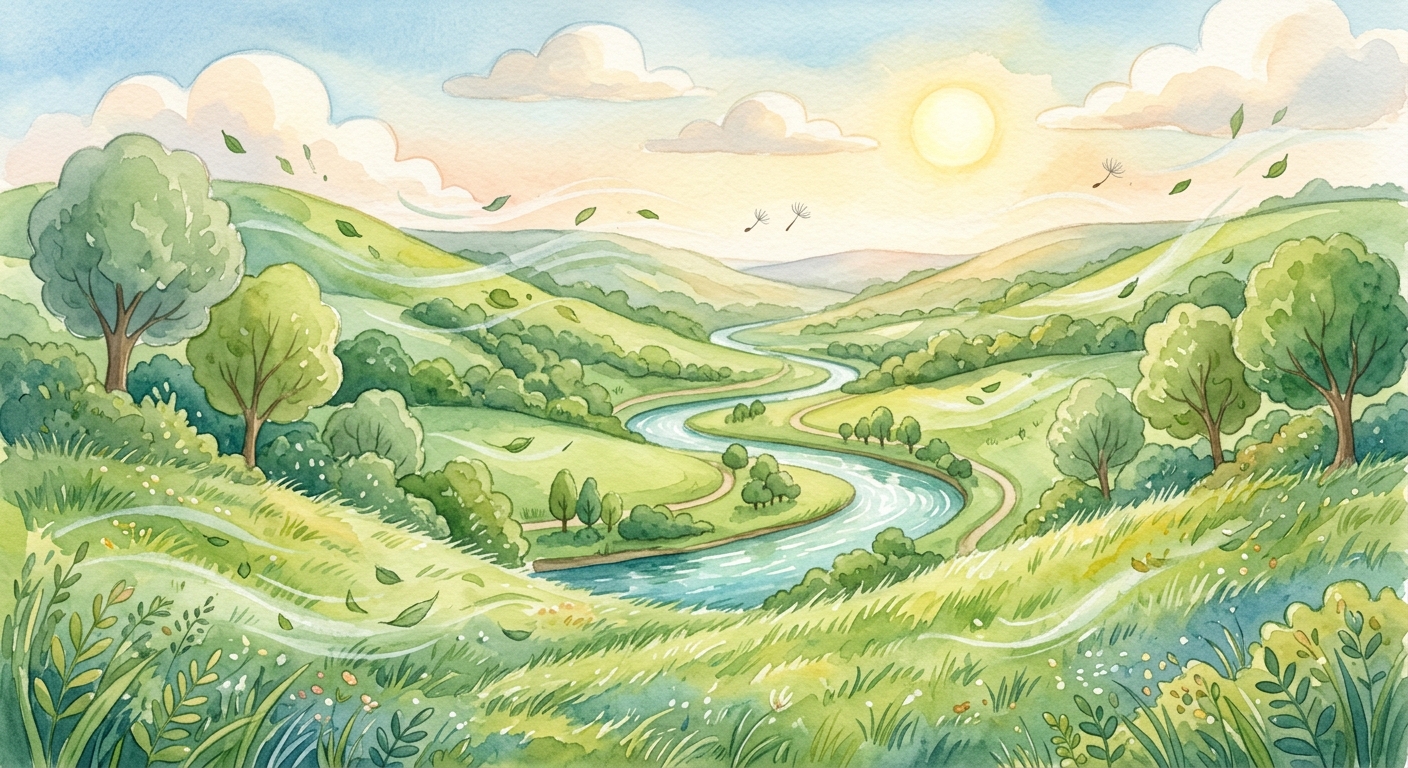
High in the green hills above a river valley, where the grass grew thick as carpet and the wind carried the smell of thyme and clover, there was a village called Millbrook. It was a small place — perhaps fifty families in all — with whitewashed houses, a stone bridge over the river, a market square with a fountain that the pigeons treated as a swimming pool, and fields that spread out in every direction like a patchwork blanket stitched together by a giant. The people of Millbrook were farmers and crafters. They grew wheat and barley in the lower fields, kept chickens and goats in their yards, and tended the flocks of sheep that grazed on the hillside pastures high above the village. The sheep were vital to Millbrook. Their thick wool was sheared each spring, spun into yarn, woven into cloth, and sold at the autumn fair in the market town, earning enough coin to see the village safely through winter. Guarding the sheep on the hillside was an honoured responsibility, passed from parent to child, and this year it had fallen to a boy named Tomas, the shepherd's son, who had just turned eleven years old.
Tomas was not a bad boy. Ask anyone in Millbrook and they would say the same thing: clever lad, good heart, just needs to sit still for five minutes. He was bright and quick-witted, with restless dark eyes and a talent for making people laugh that he wielded with the casual skill of a born performer. He could mimic the voice of any adult in the village — the gruff rasp of Henk the miller, the high nervous flutter of old Agatha who sold honey at the market, the slow thoughtful drawl of Mayor Piet — and his impersonations made even the grumpiest villagers snort with unwilling laughter. He could juggle three apples while walking backward. He could whistle complicated melodies that made the birds stop singing and listen. He could climb any tree in the valley in under a minute and had once shingled halfway up the church steeple before the minister spotted him and nearly fainted. The trouble with Tomas was not cruelty or dishonesty. The trouble was that he was bored. Utterly, profoundly, hair-pullingly, rock-kickingly, cloud-countingly bored.
Every day was the same ritual. Wake before dawn when the sky was grey and the air was cold. Eat a hunk of bread with cheese at the kitchen table while his father checked the weather through the window. Lead forty-three sheep up the winding dirt track to the high pasture, a walk that took thirty minutes and felt like three hours. Sit on a boulder. Watch the sheep eat grass. Watch the clouds drift across the vast blue bowl of the sky. Listen to the insects hum. Watch the sheep eat more grass. Eat his own lunch — more bread, more cheese, sometimes an apple. Watch the sheep eat even more grass. Lead the flock home at dusk. Eat supper. Sleep. Wake up and do it all over again. He had been doing this since April and it was now July and the boredom had become a physical sensation, a weight pressing on his chest, a buzzing in his skull, a restless itch in every muscle.
He tried everything to pass the time. He taught himself to whittle with a pocketknife his father had given him and carved an entire chess set from pine branches — thirty-two pieces with surprising detail — though he had nobody to play against except himself, which rather defeated the purpose. He learned the name of every wildflower on the hillside: yarrow, campion, harebell, self-heal. He mapped the burrows of the marmots and could predict which one would pop its head out next with eighty percent accuracy. He tried teaching tricks to the lead ewe, a dignified old sheep named Pepper, but Pepper regarded his efforts with a look of such withering contempt that he gave up after a week. He practised his mimicry, having imaginary conversations between Mayor Piet and Henk the miller, but talking to yourself for hours on end begins to feel less like entertainment and more like a warning sign.
The village had one firm rule regarding the flock, a rule so old that nobody remembered who had first made it, though it was carved into a wooden plaque that hung in the market square. If a wolf appeared near the sheep, the shepherd was to shout as loud as possible — 'Wolf! Wolf!' — and every able-bodied villager would grab whatever tool or weapon was at hand and race up the hill to defend the flock. Wolves were rare in the valley but not unheard of. The oldest villagers remembered a terrible winter thirty years back when a pack had come down from the northern mountains and taken a dozen sheep in a single night. The alarm was sacred. It meant real danger. It meant the village's livelihood was at risk. It was never, under any circumstances, to be sounded without cause. Tomas knew this rule as well as he knew his own name. His father had repeated it to him on the first morning, the second morning, and every morning for a week. But knowledge and temptation are two very different animals, and on a sweltering afternoon in the third week of July, when the heat shimmered above the rocks like water and the sheep stood in a glazed stupor and the silence was so absolute it seemed to press against his eardrums like cotton wool, temptation won.
Tomas leaped off his boulder, his heart already racing with the thrill of what he was about to do. He sprinted to the ridge where the pasture dropped away toward the valley, cupped his hands around his mouth, and bellowed with every ounce of air in his lungs: 'Wolf! Wolf! A wolf is after the sheep!' The effect was instant and extraordinary. The village erupted like a kicked anthill. Doors flew open and banged against walls. Henk the miller came charging out of the mill with his heaviest mallet, flour still dusting his forearms. Farmer Cordelia vaulted the fence of her vegetable patch, pitchfork in hand, still wearing her gardening gloves. Mayor Piet waddled up the path with surprising speed for a man of his girth, brandishing a broom as though it were a lance. Even old Agatha hobbled out of her cottage clutching a rolling pin, her face set in grim determination. Up the hill they surged, a ragtag army of bakers and weavers and farmers, their faces red with effort and white with fear, ready to face a wolf with whatever they had.
When they arrived at the top, gasping and drenched in sweat, they found Tomas sitting cross-legged on his boulder, laughing so hard he could barely breathe. The sheep grazed around him in perfect peace, not a single one disturbed. There was no wolf. There was no danger. There was not so much as an angry squirrel. There was only a bored boy and a joke that nobody else found even slightly amusing. Henk slammed his mallet into the dirt and said something that made old Agatha cover her ears. Farmer Cordelia yanked off her gardening gloves and jabbed them toward Tomas like an accusation. Mayor Piet, who was very red and very out of breath and leaning on his broom like a man who might topple at any moment, wheezed, 'Boy, do you have any idea what you have done?'
Tomas's father arrived last, because he had been re-shoeing a horse in the lower paddock when the alarm went up. He crested the ridge to find his son surrounded by a ring of furious neighbours and laughed-out, sheepish, beginning to suspect that this had not been quite as brilliant an idea as it had seemed five minutes ago. His father did not shout. He was not a shouting man. He waited until the villagers had said their piece and trudged back down the hill, muttering and cursing. Then he sat beside Tomas on the boulder, looked out over the valley, and spoke quietly. 'The alarm is a promise, Tomas. When you shout wolf, you are telling every person in this village that you need them. That their sheep, their wool, their winter income is in danger. And they drop everything — their bread, their planting, their rest — and they come running. Because they trust you.' He paused. 'Trust is not a thing you can see or hold, but it is the most valuable thing this village owns. More valuable than the sheep. Without it, we are just fifty families living near each other. With it, we are a community. Do not play games with it.'
Tomas apologised. He went door to door that evening, knocking on every house, and said sorry to every person who had come running. He meant it too, or believed he did, standing there with his hat in his hands and the last of the sunset fading behind the hills. For nine days he sat on his boulder and tended the sheep without a whisper of mischief. But on the tenth day the boredom came flooding back like a river breaking through a dam, and the memory of the villagers' faces — shocked, bewildered, gasping, ridiculous — replayed in his mind on an endless loop. He fought the temptation. He really did. He whittled until he had blisters. He counted sheep forward and backward. He recited the names of every wildflower he knew. But the itch would not go away, and on a heavy, humid afternoon when thunderheads were building over the mountains and the air tasted of copper, he cracked. He jumped up, ran to the ridge, and screamed: 'Wolf! Wolf! Help, there is a wolf!'
This time the response was markedly slower. Doors opened cautiously rather than crashing. People exchanged sceptical glances before reaching for their tools. Henk stood in the doorway of the mill for a full minute, his arms crossed, before picking up his mallet with a grunt that conveyed a paragraph of irritation. But they came. They climbed the hill, because the cost of being wrong — of ignoring a real threat — was simply too high. And once again they found Tomas grinning on his boulder, and the sheep peacefully grazing, and no wolf anywhere within a hundred miles.
This time there was no shouting. There was something far worse — a heavy, exhausted silence that settled over the hillside like fog. Henk did not slam his mallet. He simply turned and walked away without a word. Farmer Cordelia set her jaw and followed, her boots crunching on the dry grass. Old Agatha, who had struggled up the path with her bad hip and was sitting on a rock trying to catch her breath, looked at Tomas for a long, steady moment. 'I hope you never learn the real cost of this, child,' she said softly. 'But I am afraid you will.' She rose stiffly and limped back down the hill. Mayor Piet passed Tomas without even glancing at him, which felt worse than a lecture. The message was clear: you are not worth the breath. Tomas watched them go and felt a hollowness open in his chest, cold and uncomfortable. The joke was not funny anymore. But feelings fade, even the sharp ones, and boredom does not.
Summer burned slowly into autumn. The wildflowers withered. The grass turned from green to gold to pale straw. Mornings arrived with a bite of frost and a thin mist that clung to the valley until midday. The sheep's coats grew thick and heavy in preparation for the cold months ahead. Tomas wore a woollen vest and carried a blanket to the high pasture. The days were shorter now, the light sharper, the shadows longer. And on the far side of the ridge, in the dense pine forest that covered the mountain's northern face, something was moving. It was lean and grey, with a rough winter coat beginning to come in and ribs that showed faintly through its hide. Its eyes were the colour of old amber — bright, calculating, patient. It had spent the summer in the high passes where the ibex grazed, but the ibex had moved on and the wolf was hungry. It had found the scent of sheep carried on the mountain wind, and it followed that scent with the single-minded focus of an animal for which every meal is the difference between living and dying.
Tomas noticed the change on a crisp October morning. Pepper, the unflappable lead ewe who had never shown fear of anything in her long, dignified life, was standing rigid at the centre of the flock, her head high, her nostrils flaring, her eyes fixed on the tree line. The younger sheep pressed together in a tight, nervous ball, stamping and jostling, their usual spacing abandoned. One or two bleated in short, anxious bursts — not the lazy calls of sheep wanting food, but sharp, clipped sounds full of alarm. Tomas straightened on his boulder, his whittling knife forgotten in his hand. He scanned the meadow, the rock outcrops, the gully, the forest edge. He saw nothing unusual. No movement, no colour out of place. But a cold prickle ran along the back of his neck, the ancient warning that humans share with every prey animal on earth. Something was out there. Something was watching.
The wolf lay in the shadow of a fallen pine, fifty metres from the meadow's edge, its grey fur blending perfectly with the bark and stone. It watched the boy through half-closed eyes. It watched the nervous, bunching sheep. It had been observing for three days, patient as stone, learning the rhythms of the pasture — when the boy was alert, when he dozed, when the flock drifted closest to the tree line. The wind was in its favour, carrying the scent of sheep toward the forest and its own scent away from the meadow. It chose its moment the way a chess player chooses a move: late afternoon, when the sun was low and golden, casting long confusing shadows across the grass, when the boy had been sitting for hours and his attention was at its lowest ebb.
The attack was a grey blur against gold. One moment the meadow was quiet; the next, a lean shape burst from the forest edge and covered the ground with terrifying, fluid speed. The sheep erupted in every direction, bleating in raw terror, their hooves churning the dry grass. Tomas saw the wolf — truly saw a wolf for the first time in his life — a gaunt, powerful predator with its ears flat against its skull and its amber eyes locked on target. It was heading for a young lamb at the edge of the scattering flock, a lamb that had tripped on a tussock and was struggling to regain its footing. Tomas was on his feet and running before his brain had fully processed what was happening, his staff raised over his head, his voice tearing out of his throat in a raw, wordless yell.
He swung the staff and it cracked against the earth just in front of the wolf, spraying dirt and pebbles into its face. The wolf flinched, swerved, and circled back, its eyes finding Tomas and holding him in a flat, appraising stare. Tomas planted himself between the wolf and the flock, his staff raised, his heart hammering so violently he could feel it in his teeth. The wolf paced back and forth, just beyond the reach of the staff, testing, calculating, looking for a gap. It was not afraid. It was merely patient. Tomas filled his lungs and screamed toward the valley: 'Wolf! Wolf! Please — there is a wolf! A real wolf! Please help me!'
His voice echoed off the ridge and rolled down into the valley, reaching every house in Millbrook. In the mill, Henk paused. He listened. He shook his head. 'Again,' he said to his wife, and turned back to his work. Farmer Cordelia heard the shout from her barn. She closed her eyes, pressed her lips together, and continued forking hay. Mayor Piet heard it through the window of his study and did not even look up from his papers. Old Agatha heard it in her garden and stood very still for a moment, holding a jar of honey in each hand, her face troubled. But she went inside. One by one, every person in the village heard the cry and made the same calculation: the boy had lied before, twice, and once burned is cautious, and twice burned is done. The path up the hill stayed empty. Nobody was coming.
Tomas screamed until his voice gave out. He screamed until his throat felt like it had been scoured with sand and the words came out as thin, cracked whispers that the wind snatched away. The mountain path remained empty. No torches. No pitchforks. No thundering footsteps. The wolf sensed the absence of reinforcement the way a predator senses weakness — something shifted in its posture, its circling grew tighter, its feints bolder. It darted in, snapped at the air centimetres from Tomas's knee, and darted back before the staff could connect. Again. And again. Each lunge was closer than the last, each dodge more confident. Tomas's arms burned. His breathing was ragged. The staff felt heavier with every swing. Behind him, the sheep huddled in a terrified mass, their eyes white-rimmed, their bleating pitiful and constant.
But Tomas did not run. He thought about Pepper, who had led this flock for eight years. He thought about the lambs born that spring, still clumsy on their legs. He thought about every family in Millbrook that would suffer if the flock was destroyed — the wool they would not have, the cloth they could not sell, the winter they could not afford. He had failed these people. He had taken their trust and crushed it for a laugh. And now, when it truly mattered, his words were worthless. But his body was here, standing between the wolf and the flock, and that had to count for something. He gripped the staff, set his jaw, and charged at the wolf with a hoarse yell, swinging in wide, desperate arcs. The wolf snarled and gave ground, surprised by the sudden ferocity. The standoff continued, minute after agonising minute, the light fading, the shadows growing long.
It was his father who came. His father, who had been mending a fence in the lower fields, too far away to hear the first shout clearly but close enough to catch its echo on a gust of wind. His father, who had stood up slowly, tilted his head, and felt something cold and heavy drop through his chest — a father's instinct overriding every rational thought. He did not go to the village. He did not waste time trying to convince people who had already decided not to believe. He simply picked up the iron fence post he had been hammering and started running. He ran uphill for ten minutes without stopping, his lungs burning, his legs aching, the fence post heavy in his fist. When he crested the ridge he saw his son — small, pale, shaking, barely able to lift his cracked staff — facing a grey shape that paced at the edge of the fading light.
His father roared. It was a sound from somewhere deeper than voice, a sound that carried authority and fury and the primal protectiveness of a parent. He charged down the slope, fence post raised, and the wolf, faced with two opponents — one of them large, fresh, and furious — made its calculation in an instant. It wheeled, flattened its ears, and bolted into the pine forest, vanishing between the dark trunks like a shadow swallowed by shadows. Tomas's legs gave way. He dropped the broken staff and sat down hard in the grass, shaking all over. His father knelt beside him and pulled him close, and for a long minute they just sat there, father and son, while the terrified sheep milled and bleated around them and the last orange light drained from the sky.
They brought the flock down in the darkness, the father carrying a lantern that swung and cast long jumping shadows on the path. Tomas walked in silence beside him, tears making clean tracks through the dirt on his cheeks. The lamb that had been targeted was limping but alive. All forty-three sheep were accounted for. When they reached the village gate, Tomas stopped. 'I called for help,' he said. His voice was barely a whisper. 'I called and called and no one came.' His father set down the lantern and looked at him. 'Do you know why?' Tomas closed his eyes. 'Because I lied. I turned the alarm into a joke, and when the wolf was real, nobody believed me.' His father nodded slowly. 'Words are powerful things, Tomas. They can be the strongest force in the world or the weakest. It depends entirely on whether the person speaking them has earned the right to be believed.'
The next morning Tomas walked to the village square on stiff, aching legs. He was bruised from shoulder to wrist, his throat was raw, and he had not slept. He stood by the fountain and waited until a crowd gathered, drawn more by curiosity than concern. He told them the whole truth. The wolf. The fight. The empty hillside. His father's rescue. He did not embellish. He did not make excuses. He did not ask for forgiveness. He simply laid the facts out like stones on a wall, one after another, and when he was done he said, 'I broke your trust. I used your willingness to help as entertainment for my own boredom. Yesterday a real wolf came, and because of what I had done, I faced it alone. That is no one's fault but mine. I am not asking you to trust me again today. But I am going to earn it back, one day at a time, if you will let me try.'
Rebuilding trust was nothing like destroying it. Destroying it had taken a few seconds — two words shouted across a valley. Rebuilding it took months of quiet, patient, unglamorous work. Tomas built a signal beacon on the high pasture — a tall stack of dry brush and kindling that could be lit with a single match and would send a column of smoke visible from every corner of the valley. Smoke could not lie. Smoke could not joke. Smoke simply said: come. He kept a detailed journal of the flock — which sheep were healthy, which were limping, which pastures had the best grass, where he had seen tracks or droppings. He brought the journal to Mayor Piet every week and went through it page by page. He learned to read the wind and the weather. He learned the language of the sheep — the subtle signs that told him when they were calm, when they were nervous, when something had set their instincts humming. Slowly, carefully, without fanfare, he became the shepherd he should have been from the start.
The wolf returned in November, on a still morning when frost whitened the grass and the air was sharp as glass. Tomas found the tracks at dawn — fresh prints pressed into the frozen mud at the edge of the tree line, the stride long and purposeful. He did not shout. He walked calmly to the beacon and lit it. The smoke rose straight and steady into the windless sky, a pale column visible for miles. Down in Millbrook, Henk saw it from the mill window. He paused. He looked at it for a long moment. Then he picked up his mallet. Cordelia saw it from her barn and reached for her pitchfork. Mayor Piet put on his coat. Old Agatha looked up from her beehives, watched the smoke for ten seconds, and nodded. They climbed the hill — not charging this time, but steadily, purposefully. When they reached the pasture they found Tomas standing calmly with his flock, his staff in one hand, pointing to the fresh tracks in the frost with the other. The wolf had seen the smoke and the approaching figures and melted away into the pines. The system worked.
And that, dear one, is the story of the boy who cried wolf. It is a very old story, first told more than two thousand years ago by a storyteller named Aesop, and people still tell it because its lesson never grows stale. Your words carry weight. When you say something is true, people build their decisions on it. When you say you need help, people come running. That is a precious gift — perhaps the most precious gift any community can give its members — and it must not be squandered on pranks or jokes or boredom. Guard your honesty the way a shepherd guards the flock, because once trust wanders off, it is very, very hard to bring home again. But here is the part of the story people sometimes forget: Tomas did bring it home. It took patience and humility and months of quiet, thankless work, but he rebuilt what he had broken. And that matters too. Now close your eyes and rest. The hillside is quiet, the flock is safe, and the stars are keeping watch above the valley. Goodnight, little shepherd. Sleep well.