 📖 Read & Listen Free
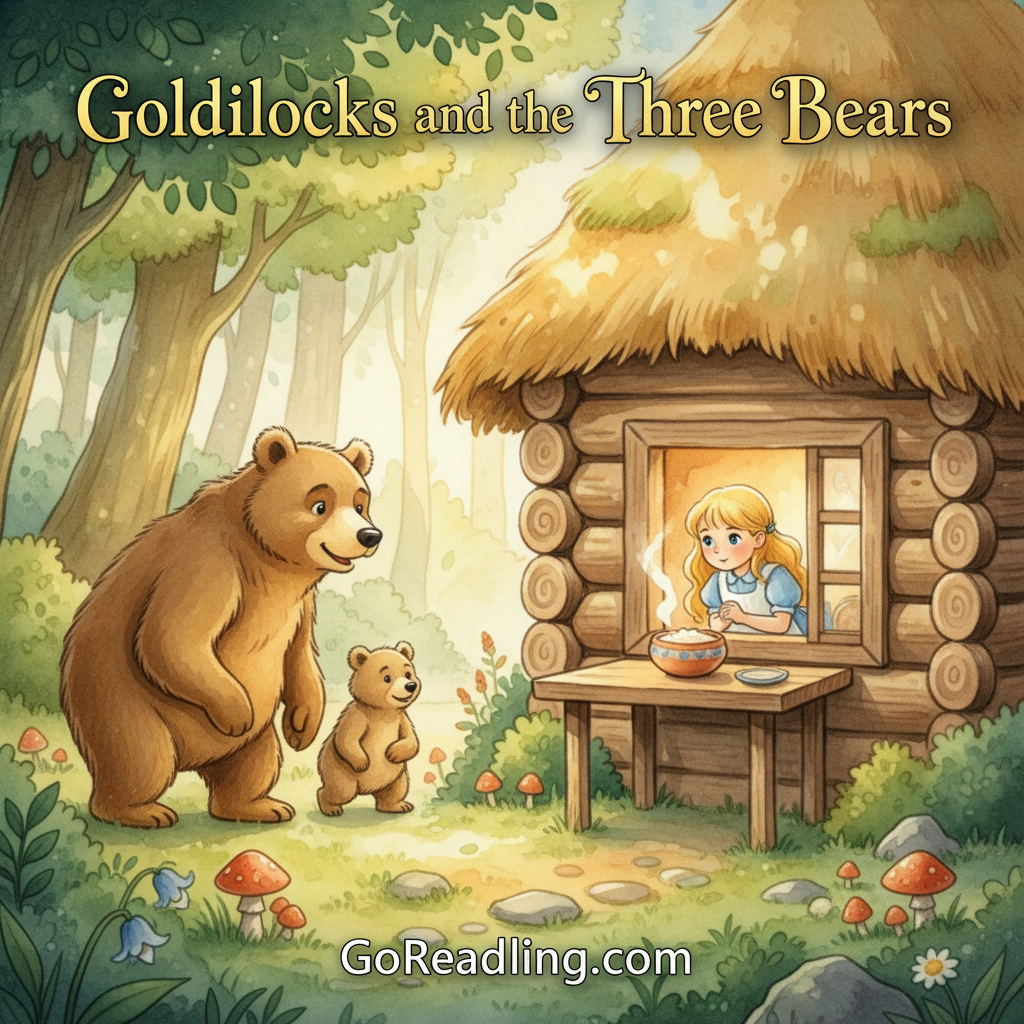
Once upon a time, on a hillside blanketed with pine trees and sprinkled with patches of wild mint, there was a sturdy little house made of river stone and timber beams. Ferns grew along its windowsills, and a crooked wooden sign nailed above the door read 'The Bruin Family'. Smoke curled from a broad stone chimney, and a vegetable garden sprawled beside the front path, with runner beans climbing up a trellis, fat cabbages swelling in neat rows, and a scarecrow made of sticks and an old straw hat standing guard over a patch of strawberries. A wind chime made of polished river stones hung from the porch beam and clinked gently in the breeze, making a sound like someone tapping a tiny xylophone. It was a house that looked exactly the way a home should look — warm, lived-in, and loved.
Inside this house lived three bears. The father was a towering brown bear with broad shoulders, enormous paws, and a belly laugh that shook the rafters and rattled the jars on the kitchen shelf. He had built the house himself, hauling stones from the riverbed and splitting timber from fallen trees, and he was immensely proud of every crooked beam and uneven flagstone. The mother was a sleek bear with clever dark eyes, a gentle manner, and paws that could braid dough into the most beautiful bread you ever saw. She kept a herb garden by the back door — rosemary, basil, thyme, chamomile — and the kitchen always smelled of something wonderful. And their cub was small and round, with ears that were slightly too big for his head, a gap-toothed grin that could charm anyone, and a boundless curiosity about the world. He collected interesting rocks, named the spiders that lived in the rafters, and kept a journal of every bird he spotted from the kitchen window. They were a happy family.
Every morning in the Bruin household began the same way. The father bear would haul a bucket of fresh water from the well at the bottom of the garden, his breath making little clouds in the cool dawn air. The mother bear would stoke the iron stove until the kitchen was toasty warm, feed the chickens that scratched in the yard, and check on her sourdough starter, which lived in a crock on the counter and which she spoke to as though it were a pet. Together they would prepare a big pot of oat porridge, stirring it slowly with a long wooden spoon worn smooth by years of use. They each had their own bowl — the father's was blue ceramic, wide as a dinner plate, with a chip on the rim from the time he had dropped it celebrating a particularly successful fishing trip. The mother's was painted with tiny forget-me-nots, a wedding present from her own mother. And the cub's was a small wooden bowl he had carved himself during a rainy weekend, lopsided and slightly too shallow but beloved because he had made it with his own paws.
On this particular morning, a bright day in early September when the air was crisp and the hillside was turning the first shades of gold, the mother bear stirred a generous drizzle of maple syrup into the pot and spooned the porridge into the three bowls. Steam rose and curled toward the ceiling, fogging the kitchen window. The father bear blew on his spoonful, tasted it cautiously, and winced. 'Still scalding,' he said, setting the spoon down. The mother nodded. 'Let us go pick blackberries while it cools. The bushes along the meadow fence should be heavy with fruit by now, and I have been wanting to make a pie.' The cub bounced on his toes, nearly knocking over the honey pot. 'Can I bring my basket? The one with the leather handle?' And so all three bears headed out through the back gate and down the slope toward the meadow, leaving the front door on the latch, the way country folk sometimes do when they expect to be home before long. The porridge sat on the table, steaming gently in the quiet kitchen, with nobody to eat it.
Meanwhile, on the far side of the meadow, beyond the blackberry bushes and past a tumbledown stone wall, a girl with a tangle of yellow curls was walking alone along a dirt lane. Her name was Goldie, though her grandmother sometimes called her Sunbeam, and she was seven years old and hopelessly nosy. She had the kind of curiosity that made her open every gate, peer into every window, lift every interesting rock, and ask 'why' so many times that adults sometimes ran out of answers. She had set out that morning to deliver a jar of pickled beets to her aunt's farm two valleys over. Her grandmother had packed the jar in a cloth sack, tied it with twine, and given Goldie careful directions: follow the lane to the fork, take the left path past the old mill, cross the stone bridge, and the farm was the first house on the right. Simple. Straightforward. Nearly impossible to get wrong.
Goldie got it wrong. She took the left path as instructed, but then a red fox trotted across the road ahead of her, its bushy tail streaming behind it like a russet flag, and Goldie absolutely had to know where it was going. She climbed over the fence and followed it through a field of tall grass. The fox slipped under a hedge. Goldie squeezed through after it, getting burrs in her hair and a scratch on her elbow. The fox darted into a copse of birch trees and vanished. Goldie straightened up, pulled a burr from her sleeve, and looked around. She did not recognise a single tree, a single rock, or a single blade of grass. The lane was gone. The old mill was gone. She had no idea which direction she had come from. The jar of beets was heavy in her arms and her stomach was rumbling loudly. She had skipped breakfast because she was in a hurry, which her grandmother always said was a recipe for poor decisions. Her grandmother, it seemed, was right about most things.
Goldie wandered uphill through the pines, hoping to find a high point where she could see the valley and get her bearings. The ground was soft with fallen needles and the air smelled of resin and earth. Birds chattered in the branches above her. A squirrel ran up a trunk so fast it seemed to defy gravity and scolded her from a branch. She walked for ten minutes, then twenty, then gave up trying to navigate and simply followed her nose, because drifting through the trees on the morning breeze came the most wonderful smell — warm oats, sweet maple, and something rich and comforting that made her stomach clench with longing. She pushed through a thicket of ferns and found herself in a clearing. And there, in the middle of the clearing, sat the stone-and-timber house with ferns on its windowsills and smoke drifting from its chimney.
Goldie walked up the garden path, past the runner beans and the cabbages and the straw-hat scarecrow. She knocked twice on the heavy wooden door. No answer. She knocked louder. Nothing. She tried the latch and the door swung inward with a low creak. 'Excuse me?' she called into the warm interior. 'Is anyone home? I am lost and rather hungry.' Silence, except for the steady tick of a clock on the mantelpiece and the faint hiss of the stove. The kitchen was straight ahead, and on the table sat three bowls of porridge, each with a spoon beside it. Goldie set down the beet jar, tucked a curl behind her ear, and told herself she would only taste a tiny bit. Just to be polite, really. Just to check if it was as good as it smelled.
She dipped the big blue spoon into the father's bowl and immediately spat the porridge back with a gasp. It was blisteringly, tongue-scorchingly hot. She fanned her mouth and moved to the mother's bowl, painted with its delicate forget-me-nots. She took a careful sip and grimaced — it had cooled past the point of comfort into something lukewarm and gluey, with a skin forming on the surface. Then she noticed the small lopsided wooden bowl. She picked up its little spoon and tried a mouthful. Warm, sweet, perfectly thick, the maple syrup swirled through it in golden ribbons. Before she could stop herself she had eaten every last bite, tilting the bowl to scrape the sides, running her finger around the rim to catch the last smear. She set the empty bowl down and felt a stab of guilt. That had been someone's breakfast. Someone small, judging by the size of the bowl.
Feeling guilty but also pleasantly full, Goldie wandered into the sitting room. A stone fireplace took up most of one wall, with a mantelpiece crowded with pinecones, dried flowers, and framed drawings that looked like they had been done by a child — or a cub. Three seats were arranged in a semicircle facing the hearth. The first was a wide rocking chair built from knotty pine, with a thick sheepskin thrown over the back. She climbed in, but it rocked so violently at the slightest movement that she gripped the armrests in alarm, swaying back and forth like a ship in a storm. 'Too wobbly,' she muttered, and scrambled out. The second was a deep cushioned armchair draped with a knitted blanket in shades of green and cream. She sank into it and kept sinking until her chin was level with her knees and her feet stuck straight out in front of her. 'Too squishy,' she said, struggling to extract herself from the chair's soft embrace. In the corner stood a small three-legged stool painted cherry red, with a round seat just the right size for a seven-year-old. Goldie sat down with a contented sigh. She wiggled to get comfortable, leaned sideways to look at a picture on the wall — and crack. One leg buckled beneath her, spilling her onto the rag rug in a heap of splinters and surprise.
Goldie stared at the broken stool, her cheeks burning. She tried to fit the leg back on but it would not hold; the joint had split right through the grain. She set the pieces together as neatly as she could, propping the broken leg against the seat, and tiptoed upstairs, thinking she might find someone to apologise to. Perhaps they were napping. At the top of the narrow staircase she found a bedroom with three beds lined up under a sloped ceiling, each with a window looking out over the pine-covered hillside. The first bed was large and firm, with a straw mattress that prickled through the sheet and a bolster pillow hard as a log. The second bed was medium-sized, piled so high with feather pillows and quilts that she could not find a flat spot to rest her head — every time she pushed one pillow aside, two more seemed to take its place. The third bed was small, with a firm cotton mattress, a patchwork quilt sewn in a pattern of acorns and oak leaves, and a single well-stuffed pillow. Goldie lay down meaning only to rest for a moment while she figured out what to do. The mattress supported her perfectly. The quilt was soft and smelled faintly of lavender. In less than a minute, her eyes closed, her breathing deepened, and she was fast asleep, her yellow curls fanned across the acorn quilt like spilled sunshine.
Down in the blackberry thicket at the far edge of the meadow, the cub's basket was overflowing with dark, plump berries and his muzzle was stained purple from the ones he had taste-tested, which was most of them. The mother bear tucked one last handful into her apron pocket and straightened up. 'That should be more than enough for a pie,' she said, brushing a leaf from her fur. 'Let us head back — the porridge will be perfect by now, and I am getting hungry.' They ambled home along the creek path, the father humming a deep tune that made the pebbles seem to vibrate, the cub skipping ahead and stopping every few steps to examine a beetle or a mushroom. When they reached the front door, the father paused. His nose twitched. 'I closed this door,' he said slowly, his voice dropping to a low rumble. He pushed it open and the three bears stepped inside.
The father bear went straight to the table and stared at his blue bowl. The spoon was resting at a different angle and a dribble of porridge marked the chipped rim. 'Someone has been at my porridge,' he said, his voice low and deliberate. The mother bear examined her forget-me-not bowl. A spoonful was clearly missing, the surface disturbed, and a small sticky fingerprint marked the handle of her spoon. 'Someone has been at mine as well,' she said, a crease of worry forming between her eyes. The cub looked at his lopsided wooden bowl. It was completely empty — not even a smear left on the bottom. The little spoon lay beside it, licked clean. His lip quivered. 'Someone ate all of mine,' he whispered, and his voice was so small and sad that the mother bear immediately put her paw on his shoulder.
The bears moved into the sitting room. The father saw the rocking chair still swaying faintly, the sheepskin pushed to one side. 'Someone has been in my chair,' he growled. The mother noticed the dent in her armchair cushion, so deep it held the impression of a small body, and her knitted blanket trailing on the floor. 'And in mine,' she said, bending to fold it. The cub rounded the corner and let out a gasp. His cherry-red stool lay in pieces — the seat on its side, one leg snapped clean off, the other two splayed like fallen branches. He gathered up the pieces and held them against his chest, his oversized ears drooping flat against his head. 'My stool,' he said quietly. 'I painted it myself.' The mother put her arm around him. 'Hush now. We will mend it together. Things that are loved can be fixed.' But the question hung in the air, unspoken and uneasy: who had done all this?
The three bears crept upstairs, the father leading the way, each stair creaking under his weight. In the bedroom the father saw his straw mattress rumpled, the bolster pillow shoved to the foot of the bed, and the sheet twisted sideways. 'Someone has been on my bed,' he said, his rumble barely above a whisper. The mother saw her tower of pillows toppled and scattered across the quilt like a snowdrift after a gale. 'And on mine.' The cub peered around his mother's broad hip and froze. Curled up under his acorn-and-oak-leaf quilt, breathing softly, with a halo of messy yellow curls on his pillow, was a small person. A girl, about his own age in human years. 'There is a girl in my bed!' he squeaked, so startled that his voice came out much louder than he intended, echoing off the sloped ceiling.
Goldie's eyes flew open. Three furry faces loomed above her — one enormous, one medium, one small with comically oversized ears. She yelped, scrambled backward until her shoulders hit the wooden headboard, and clutched the quilt to her chin like a shield. Her heart hammered so loudly she was certain the bears could hear it. For a long, frozen moment nobody moved. The clock downstairs ticked into the silence. Then the cub tilted his head to one side, his expression shifting from alarm to open curiosity, and said, in a voice that was puzzled rather than angry, 'Why are you in our house?'
Goldie's eyes filled with tears — not from fear, though she was afraid, but from a hot rush of shame. She had walked uninvited into someone's home, eaten their food, broken their furniture, and fallen asleep in their bed. Her grandmother would be mortified. 'I got lost,' she said, her voice wobbling badly. 'I was bringing pickled beets to my aunt's farm and I followed a fox off the road and then I could not find my way back. I was so hungry, and your door was open, and the porridge smelled so good, and I only meant to try a little but I ate the whole bowl, and then I sat in the stool and it broke, and I fell asleep because I was tired and the quilt was so warm and I am so, so sorry.' She pulled her knees to her chest and looked directly at the cub. 'Especially about your stool. And your porridge. I will replace them, I promise.'
The father bear folded his enormous arms and studied the girl with an expression that was hard to read. The mother bear studied her too, noting the scratched knees, the burrs in her hair, the rumpled dress, and the genuine tremor in her voice. This was not a girl who had come to cause trouble. This was a girl who had wandered too far and made a string of poor decisions fuelled by hunger and curiosity. It was the cub who broke the silence. 'Are you still hungry?' he asked. Goldie blinked in surprise. 'A little,' she admitted. The cub looked up at his mother with hopeful eyes. 'Can we make more porridge? And maybe use the blackberries for pie?' The mother bear exhaled through her nose — half sigh, half laugh — and said, 'I suppose we can.' The father bear unfolded his arms and said, in his deep rumbling voice, 'But first you will help us clean up the mess you made.'
Goldie threw herself into the work. She scrubbed all three bowls and the pot until they gleamed, dried them carefully with a cloth, and set them back on the shelf in the right order. She swept up every splinter from the broken stool and mopped the sticky fingerprint off the spoon handle. She restuffed pillows and straightened sheets and folded the knitted blanket so precisely that the mother bear raised an impressed eyebrow. When the kitchen was spotless, the mother bear set a fresh pot of porridge on the stove, and while it cooked she showed Goldie how to roll blackberry pie dough on the floured table, pressing the edges with the tines of a fork to make a scalloped crust. The cub sat on the counter and handed them berries one at a time, eating every third one himself, his muzzle turning progressively more purple. The father bear retreated to his workshop behind the house — a small shed fragrant with sawdust and linseed oil — and returned carrying the broken stool. He laid the pieces on the table. 'Do you want to learn how to fix what you broke?' he asked Goldie. She nodded quickly, her eyes wide and earnest. He showed her how to sand the splintered ends smooth, apply wood glue carefully along the grain, fit the pieces together, and clamp the joint tight with a C-clamp. 'It needs to dry overnight,' he said, 'but tomorrow it will hold better than it did before. That is the strange truth about mending — the repaired place often ends up stronger than the original.'
They ate together at the oak table — fresh porridge with maple syrup and warm blackberry pie with a golden, buttery crust that shattered when you pressed your fork through it. Goldie ate two helpings of everything and the cub ate three. The mother bear poured mugs of chamomile tea from her herb garden, sweetened with honey from the beehive behind the vegetable patch. The father bear told a story about the time he accidentally sat on a beehive during a picnic, which made Goldie laugh so hard tea nearly came out of her nose. The cub showed her his collection of interesting rocks — a smooth one shaped like an egg, a sparkly one with flecks of mica, a flat one that was perfect for skipping — and his whittled animals, and the battered old book of poems that had belonged to his grandmother. Goldie read a poem aloud in a clear, steady voice, and the three bears clapped when she finished.
When the shadows outside grew long and the light through the kitchen window turned amber, Goldie remembered her aunt, and her grandmother, and the jar of pickled beets still sitting on the table where she had left it hours ago. 'I have to go home,' she said, her voice suddenly small and reluctant. 'My grandmother will be worried sick.' The father bear nodded. 'We know these hills as well as anyone. We will walk you to the lane.' The four of them set off through the pines, the cub holding Goldie's hand, the mother bear carrying the beet jar since Goldie's arms were tired. The mother pointed out landmarks along the way — a split boulder shaped like an open book, a hollow oak with a beehive in its trunk, a creek crossing with three flat stepping stones in a row. 'Follow those markers and you will always find your way back to our door,' she said. Goldie looked at her, astonished. 'You would let me come back? After everything I did?' The mother bear smiled, which on a bear is a slow, warm lifting of the muzzle that crinkles the fur around the eyes. 'Knock first next time.'
They reached the lane just as the sky turned apricot and rose and the first bats came flittering out over the meadow. Goldie could see her aunt's farmhouse chimney in the distance, trailing a thin line of smoke. She turned and faced the three bears. 'Thank you,' she said, and the words felt too small for what she meant by them. 'For the food, and the pie, and the mending lesson, and for not being angry with me, even though you had every right to be.' The cub threw his arms around her waist in a fierce hug. 'Come back on Saturday,' he said into her shoulder. 'We are going fishing at the deep pool and I can show you the waterfall where the kingfishers live.' Goldie hugged him back, then the mother, then stretched up on tiptoe to hug the father bear, who had to bend nearly double. She took the beet jar, waved once more from the lane, and set off toward her aunt's farm at a trot, her yellow curls bouncing.
The very next Saturday, Goldie returned — this time with permission, with directions written on a piece of paper in case of foxes, and with a loaf of her grandmother's walnut bread wrapped in a clean cloth as a gift. She followed the markers — the split boulder, the hollow oak, the three stepping stones — and knocked firmly on the front door. The cub flung it open, already wearing a floppy fishing hat that was much too big for his head. They spent the day at the creek, catching silver trout and skipping stones and eating cheese sandwiches on a flat rock in the middle of the current with their bare feet dangling in the icy water. At the waterfall the cub dared Goldie to stick her head under the cascade, and she did, shrieking with cold, and then he did too, and they both came out shivering and grinning. Over the weeks that followed, Goldie became a regular visitor. She helped the mother bear bake bread, learning to braid the dough into spirals. She helped the father bear chop kindling, although she could only manage the thinnest sticks. She and the cub built a fort from fallen branches in the meadow and declared it the headquarters of the Pine Hill Explorers' Club, membership: two. In autumn they pressed red and gold leaves inside the grandmother's poem book. In winter the cub taught Goldie to read animal tracks in the snow, and Goldie taught the cub to play checkers using hazelnuts and acorns on a board scratched into a flat stone.
Goldie also learned something she had not expected, something that changed the way she moved through the world. She learned that curiosity was a fine thing — one of the finest things a person could have — but that curiosity paired with courtesy was finer still. Walking through someone's open door because you are hungry is one thing. Knocking and waiting is another. Tasting someone's food without asking is one thing. Sitting at their table as an invited guest, helping to cook and wash up afterward, is another. She had stumbled into the bears' home and taken what was not hers, and they had answered her trespass with generosity. That generosity changed her. She stopped barging through hedges and climbing strangers' fences. She started asking before touching, listening before speaking, and thinking before acting — not because she was afraid of getting into trouble, but because she understood that the world was full of other people's homes and other people's porridge, and that the kindest way to move through it was gently.
On a quiet evening in late spring, the Bruin family sat together in their sitting room while a soft rain pattered against the windows. The father rocked in his pine chair, reading poems aloud in his deep, rumbling voice, each verse rolling through the room like warm thunder. The mother knitted by the fire, her needles clicking in steady rhythm, working on a pair of mittens for the cub. And the cub perched on his cherry-red stool — mended, glued, clamped, and stronger than ever — turning the pages of a sketchbook Goldie had given him, filled with drawings of their adventures together: the waterfall, the fort, a trout leaping from the creek, the two of them covered in flour during a bread-making disaster. On the mantelpiece sat a jar of pickled beets that had never made it to the aunt's farm, now serving as a vase for a bunch of wildflowers the cub had gathered that morning. Outside, the pines whispered in the rain and the first stars appeared in the gaps between the clouds. Everything was warm, everything was mended, and everything was exactly where it belonged. Goodnight, little one. Close your eyes and dream of pine-covered hillsides and blackberry pie and friendships that begin with mistakes and grow into something wonderful. Sleep well.