 📖 Read & Listen Free
Once upon a time, in a little village tucked between rolling green hills and a dark, whispering forest, there lived a husband and wife who wanted nothing in the world so much as a child. Their names were Thomas and Elsa, and they had been married for seven years, and for seven years they had hoped and wished and prayed, but no child had come to them. Their cottage was small but cheerful, with a thatched roof and a garden full of herbs and flowers, and Thomas worked as a carpenter, building chairs and tables and window frames for the people of the village. Elsa was a seamstress who could sew the most delicate stitches you ever saw, tiny flowers and birds and leaves on linen so fine it looked like spider silk. They were good people, kind to their neighbors, gentle with animals, honest in their dealings, and yet this one great happiness was denied to them, and it cast a shadow over their days that no amount of sunshine could quite chase away.
Now, next to their little cottage, separated by a high stone wall covered in ivy and moss, there was a magnificent garden. It was the most beautiful garden in the whole countryside, bursting with flowers of every color, with fruit trees heavy with apples and pears and plums, and with rows upon rows of vegetables and herbs so lush and green that they seemed to glow with an inner light. But no one ever dared to enter that garden, because it belonged to Dame Gothel, a woman of great and terrible power. Some called her a witch, others called her an enchantress, and still others simply called her nothing at all, because they were too frightened to speak her name. She lived in a tall stone house beyond the garden, and she was rarely seen in the village, but when she appeared, people stepped aside and lowered their eyes and hurried on their way.
One spring morning, Elsa was standing at the upstairs window, looking down into Dame Gothel's garden, when she noticed a bed of rapunzel growing near the wall. Rapunzel is a plant with tender green leaves that can be eaten in salads, and these particular plants were the finest Elsa had ever seen, their leaves a deep, shimmering emerald green, so fresh and crisp and inviting that her mouth began to water just looking at them. She had been feeling unwell for several days, tired and queasy and unable to eat, and suddenly the rapunzel was the only thing in the world she wanted. The craving was so powerful it was almost painful, like a hook lodged deep in her chest, pulling her toward those green leaves on the other side of the wall. She tried to ignore it. She made herself soup. She ate bread and cheese. She drank peppermint tea. But nothing helped. The craving only grew stronger.
Days passed, and Elsa grew pale and thin. She could not eat, could not sleep, could barely bring herself to get out of bed. All she could think about was the rapunzel in Dame Gothel's garden, those beautiful green leaves glistening with morning dew. Thomas was terrified. He brought her broths and custards, he called for the doctor from the village, he sat by her bedside and held her hand, but nothing made any difference. Finally, one evening, Elsa turned to him with hollow eyes and whispered, 'If I cannot have the rapunzel from that garden, Thomas, I believe I shall waste away and die.' Thomas was a sensible man, not given to foolish risks, but he loved his wife more than anything, and the look in her eyes frightened him more than any enchantress ever could.
That night, when the moon was hidden behind thick clouds and the village was dark and silent, Thomas crept out of the cottage, climbed the ivy-covered wall, and dropped quietly into Dame Gothel's garden. His heart was hammering so loudly he was certain the whole world could hear it. The garden was eerily beautiful by starlight, the flowers pale and ghostly, the herbs releasing their fragrance into the cool night air. He found the rapunzel bed quickly, snatched up a great handful of the green leaves, stuffed them into his shirt, and scrambled back over the wall, his hands trembling, his breath coming in ragged gasps. He had done it. He was safe. Elsa ate the rapunzel in a salad and the color returned to her cheeks immediately, as if she had drunk some magical tonic. She ate every leaf and licked the bowl clean and then looked at Thomas with grateful, shining eyes.
But the rapunzel only made the craving worse. The next day Elsa wanted more, and the day after that even more, and within a week Thomas had climbed the wall three times, each time bringing back more of the enchantress's precious rapunzel. On the fourth night, just as Thomas had filled both his arms with the green leaves, a voice spoke from the darkness behind him, cold and clear as ice cracking on a winter pond. 'So. You are the thief who has been stealing my rapunzel.' Thomas spun around and there was Dame Gothel, standing among her roses, her silver hair gleaming in the moonlight, her dark eyes boring into him like twin needles. Thomas fell to his knees, the rapunzel tumbling from his arms and scattering across the earth. He begged for mercy. He explained about his wife, about her illness, about the terrible craving that was consuming her.
Dame Gothel listened in silence, her expression unreadable, her thin lips pressed together in a line as straight and sharp as a blade. When Thomas had finished his stammering explanation, she was quiet for a long moment. Then she spoke. 'Very well,' she said, and her voice was like the sound of a key turning in an old lock. 'You may take as much rapunzel as you wish. Your wife may eat her fill. But there is a price.' Thomas, still kneeling in the dirt, looked up at her with wide, frightened eyes. 'When the child is born,' Dame Gothel continued, and please do not look so surprised, Thomas, yes, your wife is with child, that is the reason for her cravings, 'you will give the baby to me. I will raise it as my own. It will want for nothing. It will be well cared for and well fed and protected from all harm. That is my price, and it is not negotiable.'
Thomas wanted to refuse. Every fiber of his being screamed at him to refuse, to throw the rapunzel in the enchantress's face and run. But the thought of Elsa, pale and wasting in her bed, the thought of the child they had wanted for so long, dying before it was even born because its mother could not eat, was more than he could bear. With tears streaming down his face and shame burning in his chest like a coal, Thomas agreed. Dame Gothel smiled, a smile that was not cruel but was not kind either, something ancient and complicated that Thomas could not begin to understand. She gathered up the scattered rapunzel, added more from the bed, and handed him the great green bundle. 'Go home to your wife,' she said. 'And remember your promise.'
The months passed, and Elsa grew round and healthy, and on a cool autumn evening, with the leaves turning gold and red outside the window and a fire crackling in the hearth, she gave birth to a beautiful baby girl. The child had a tuft of golden hair, fine as corn silk, and eyes as blue as the summer sky, and when she cried her voice was as clear and sweet as a silver bell. Thomas and Elsa held their daughter and wept with joy, and for one brief, golden hour they forgot their terrible promise and were simply parents, dazzled by the miracle of new life. But then there was a knock at the door, three slow knocks, deliberate and unhurried, and when Thomas opened it, Dame Gothel was standing on the step, wrapped in a dark green cloak, her silver hair shining in the lamplight.
She did not speak harshly. She did not snatch the child. She simply held out her arms, and the look in her eyes was not wicked but hungry, the look of someone who has been alone for a very long time and wants, more than anything, someone to love. Thomas placed the baby in her arms, and Elsa sobbed as if her heart would break into a thousand pieces, and Dame Gothel looked down at the tiny golden-haired child and said, very softly, 'I shall call her Rapunzel, after the plant that brought her to me.' Then she turned and disappeared into the night, and the cottage that had been so briefly filled with the warmth and wonder of a newborn baby was silent and cold once more. Thomas held Elsa while she cried, and he made her promises he could not keep, and outside the wind blew the autumn leaves in great golden spirals down the dark and empty lane.
Dame Gothel kept her word. Little Rapunzel wanted for nothing. She was fed the finest foods, dressed in the softest clothes, educated by the enchantress herself in reading and writing and music and botany and the names of every star in the sky. Dame Gothel loved the girl fiercely, possessively, with a love that was real but twisted, like a vine that wraps so tightly around a young tree that it eventually strangles it. She was terrified of losing Rapunzel, terrified that the world would take her away, and so she kept her close, always close, never letting her play with other children, never letting her wander beyond the garden walls. Rapunzel grew into a cheerful, curious child with a laugh like running water and hair that grew and grew and grew, never cut, never trimmed, golden as sunshine and impossibly long, trailing behind her like a river of light.
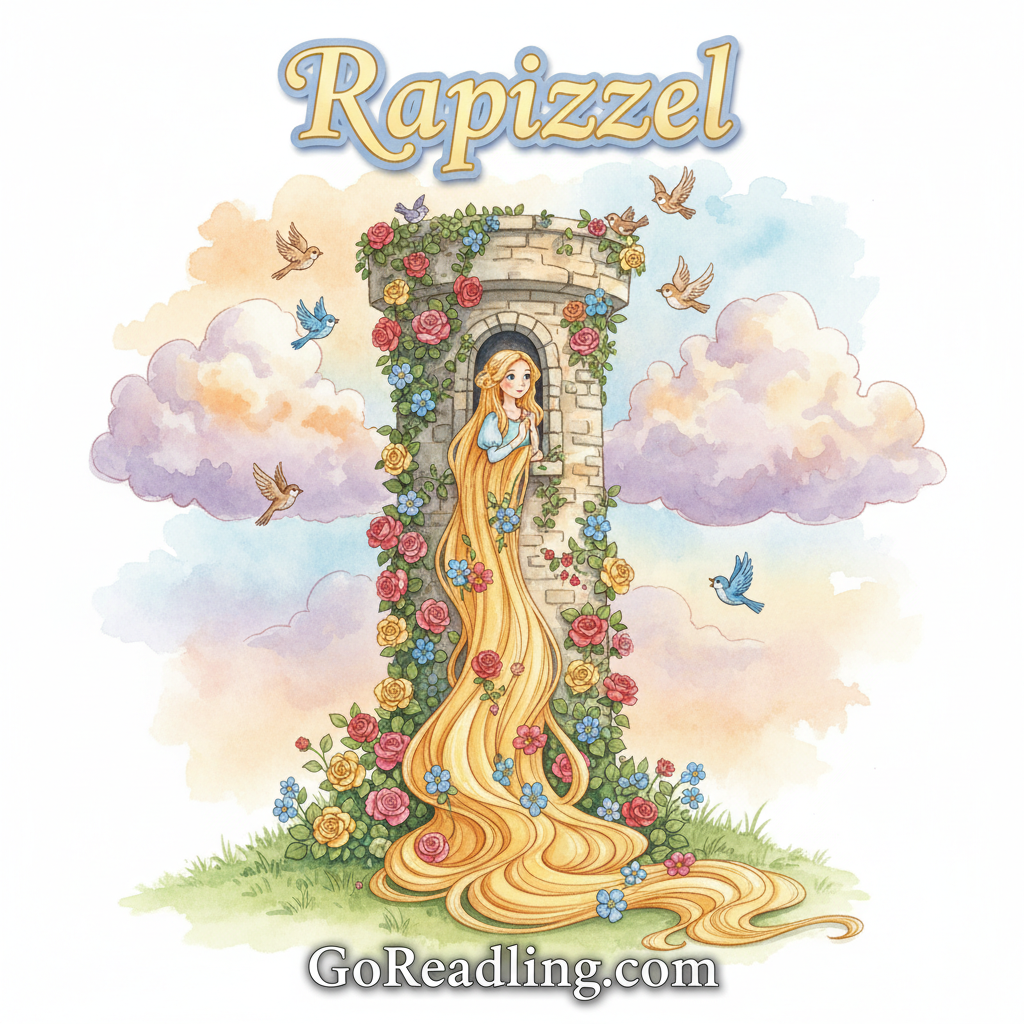
When Rapunzel was twelve years old, Dame Gothel made a decision born of fear and love, those two emotions that so often walk hand in hand. Deep in the forest, in a clearing surrounded by ancient oaks and silver birch trees, there stood a tall stone tower with no door and no staircase, only a single window at the very top. It had been built long ago by someone whose name was forgotten, and it rose straight up from the forest floor like a great stone finger pointing at the sky. Dame Gothel took Rapunzel to this tower and installed her in the room at the top, a round, comfortable room with a bed and a bookshelf and a fireplace and a little table by the window. The walls were hung with tapestries to keep out the cold, and there was a rug on the stone floor and candles on every surface, and Dame Gothel had tried, in her way, to make it homelike.
Rapunzel did not understand at first. She thought it was a game, an adventure, a special holiday in the forest. But when she realized that there was no way down, no door, no stairs, only the sheer stone walls dropping fifty feet to the ground, she cried and beat her fists against the window ledge and begged Dame Gothel to take her home. Dame Gothel held her and stroked her golden hair and whispered that it was for her own protection, that the world outside was dangerous and cruel and full of people who would hurt her, and that she was safe here, safe and loved and cared for, and that was all that mattered. Rapunzel was a child, and children trust the people who love them, even when that love comes wrapped in chains as fine as silk and invisible as air. She dried her eyes and tried to make the best of it, because what else could she do?
The years passed, and Rapunzel grew from a girl into a young woman, and her hair grew with her, long and longer still, until it was twenty feet of shimmering gold that she coiled and braided and wound around hooks on the wall to keep it from tangling beneath her feet. Every day she read her books and tended the little pots of herbs that Dame Gothel brought her, and she sang. Oh, how she sang. Rapunzel had a voice of extraordinary beauty, clear and pure and achingly sweet, a voice that could make the birds stop in the trees and listen, a voice that carried on the wind and drifted through the forest like something alive. She sang because she was lonely, and because music was the one thing that could not be locked in a tower, the one thing that could fly out through the window and travel wherever it pleased.
Each day, Dame Gothel came to visit, bringing food and books and fresh candles and clean clothes. She would stand at the base of the tower and call up in her sharp, clear voice, 'Rapunzel, Rapunzel, let down your hair!' And Rapunzel would unwind her long golden braid, loop it around the hook beside the window, and let it fall down the side of the tower like a rope of sunlight. Dame Gothel would take hold of the braid and climb up, hand over hand, her feet braced against the stone, and Rapunzel would help pull her in through the window. It hurt, of course. The weight of a grown woman pulling on your hair is not a pleasant thing. But Rapunzel had grown used to the pain, the way you grow used to any small cruelty that is repeated day after day until it feels almost normal.
Dame Gothel would sit with Rapunzel for hours, teaching her, talking to her, brushing her extraordinary hair with a silver-backed brush, one hundred strokes each evening until it gleamed like liquid gold in the candlelight. She told Rapunzel stories about the wickedness of the world beyond the forest, about thieves and liars and people who would use her and abandon her and break her heart. She painted such a vivid picture of the ugliness and danger outside that Rapunzel, who had never known anything else, believed every word. The tower was her home, the enchantress was her mother, and the world was a terrifying place best observed from a safe distance through a small high window. But somewhere deep inside her, in a quiet room in her heart that Dame Gothel's words could not quite reach, Rapunzel wondered.
Now it happened that a prince named Julian was riding through the forest one afternoon in early spring. He was the youngest son of the king, a thoughtful young man of twenty with dark curly hair and kind brown eyes, and he was not hunting or questing or doing any of the grand things that princes are supposed to do. He was simply riding because he loved the forest, loved the way the light fell through the canopy in long golden columns, loved the smell of earth and moss and wild garlic, loved the silence that was not really silence at all but a thousand tiny sounds woven together into something like music. His horse, a gentle gray mare named Cloud, picked her way carefully along the narrow path, and Julian let her choose the way, content to follow wherever she led.
And then he heard it. A voice, rising from somewhere deep among the trees, so beautiful that it stopped him in his saddle as surely as if someone had placed a hand on his chest and pushed. The song had no words that he could make out, just a melody, rising and falling like water flowing over stones, like wind moving through leaves, like all the beautiful, nameless longings of the human heart given form and sound. Julian dismounted and tied Cloud to a branch and followed the voice through the undergrowth, pushing through ferns and brambles, stepping over fallen logs, drawn forward by that extraordinary sound the way a moth is drawn to a candle flame. He came at last to a clearing, and there was the tower, tall and gray and impossibly high, and at the top, framed in the narrow window, he could see a cascade of golden hair and the silhouette of a young woman singing.
Julian stood behind an oak tree and watched, hardly daring to breathe. He could not see how to get up to the window. There was no door, no ladder, no staircase winding up the outside of the tower. The stone walls were smooth and sheer and offered not a handhold nor a foothold. He stood there for a long time, listening to the singing, and then he heard footsteps approaching through the forest. He pressed himself deeper behind the oak and watched as an older woman in a green cloak appeared in the clearing. She stood at the base of the tower and called up, 'Rapunzel, Rapunzel, let down your hair!' And a moment later, a long golden braid came tumbling down from the window, and the woman climbed up it and disappeared inside. Julian's eyes went wide. He committed every detail to memory, the words, the braid, the window, and then he crept silently back to Cloud and rode home with his head spinning and his heart full of wonder.
The next evening, after watching from behind his oak tree to make sure Dame Gothel had gone, Julian stepped into the clearing. The tower was dark against the evening sky, and the first stars were appearing above the treetops. He stood where he had seen the enchantress stand, tipped his head back, and called up in a voice that trembled only slightly, 'Rapunzel, Rapunzel, let down your hair!' There was a pause, a long, breathless pause during which Julian's heart thudded painfully in his chest, and then the golden braid came tumbling down, heavy and warm and gleaming in the fading light. He hesitated for just a moment, then took hold of the braid and began to climb, pulling himself up hand over hand the way he had seen the enchantress do, his boots finding purchase against the rough stone.
When he reached the window and swung himself inside, Rapunzel gave a cry of shock and stumbled backward, knocking over a stack of books. She had never seen a young man before. She had never seen anyone except Dame Gothel. Julian stood in the middle of her small round room, breathing hard from the climb, his dark curls wild and his eyes wide, and for a moment neither of them could speak. Then Julian bowed, because his mother had taught him that manners matter most when you are most uncertain, and said, 'I beg your pardon for startling you. My name is Julian. I heard you singing, and I have never heard anything so beautiful in all my life.' Rapunzel looked at him. He did not look wicked or dangerous or cruel. He looked nervous and kind and slightly out of breath, and his eyes were the warm brown color of hazelnuts.
They talked. That first evening they talked for two hours, sitting on opposite sides of the little room, Rapunzel on her bed and Julian on the wooden stool by the fireplace, and they told each other everything. Julian talked about the world outside, about the village and the castle and the market where you could buy oranges and cinnamon and bolts of colored silk. He talked about music and horses and the way the sea looked at sunset, all silver and gold and endless. Rapunzel listened with her eyes as round as moons and her lips slightly parted and her golden hair pooled around her like a lake of light. She had never imagined that the world could contain such wonders. It was not the ugly, dangerous place Dame Gothel had described. It was magnificent, and terrifying, and she wanted to see every inch of it.
Julian came back the next evening, and the evening after that, and soon he was visiting Rapunzel every night, always after Dame Gothel had made her daytime visit and departed. They became friends first, the way the best loves always begin, sharing stories and books and laughter and the small, precious details of their very different lives. Julian brought her gifts, nothing grand, just a handful of wildflowers, a ripe peach, a ribbon for her hair, a small mirror so she could see her own face, which she had not seen properly in years. Rapunzel gave him songs, each one more beautiful than the last, songs she composed just for him about the things he described, the sea, the market, the sunrise over the castle walls. Slowly, carefully, the way a flower opens in sunlight, they fell in love.
One day, Rapunzel made a mistake. It was summer, and Dame Gothel was pulling herself up the golden braid, puffing and grunting with the effort, and Rapunzel, without thinking, said, 'Why is it, Mother Gothel, that you are so much heavier to pull up than Julian? He climbs so lightly, like a squirrel on a branch.' The words were barely out of her mouth before she realized what she had done. The color drained from her face. Dame Gothel heaved herself through the window and stood there, and her expression was something that Rapunzel had never seen before, a fury so cold and deep it was like looking into the heart of a glacier. 'What have you done?' Dame Gothel whispered, and her voice was barely audible, a thin hiss like steam escaping from a crack in the earth. 'I trusted you. I loved you. I kept you safe from the world, and you have betrayed me.'
What happened next was swift and terrible. Dame Gothel seized the great golden braid and, with a pair of iron scissors that seemed to appear from nowhere, cut it off close to Rapunzel's head. The braid fell to the floor in a heavy, shimmering coil, and Rapunzel cried out, not from physical pain, though there was that too, but from the shock of it, the brutality of it, the finality. Dame Gothel did not speak. She did not explain or lecture or rage. She simply took Rapunzel by the arm and, by some enchantment that Rapunzel did not understand, they descended from the tower and walked deep, deep into the forest, further than Rapunzel had ever been, to a desolate stretch of wilderness where the trees were thin and twisted and the ground was rocky and barren. There Dame Gothel left her, alone, without food or shelter, in a place so remote that not even the birds seemed to visit.
That same evening, Julian came to the tower as usual. He stood in the clearing and called up, 'Rapunzel, Rapunzel, let down your hair!' And the golden braid came tumbling down. Julian took hold of it and climbed, his heart light, his mind full of the story he wanted to tell Rapunzel about a pair of swallows he had seen building a nest above his window. But when he reached the top and swung himself in through the window, it was not Rapunzel who greeted him. It was Dame Gothel, standing in the shadows with the severed braid wound around the window hook, her eyes gleaming with a cold and terrible satisfaction. 'So,' she said, very quietly. 'The little bird has flown, and the cat has come to an empty nest.' Julian stared at her, and his blood turned to ice in his veins.
Dame Gothel's voice was low and measured, each word placed with the precision of a surgeon's knife. 'You will never see her again,' she said. 'She is gone. I have sent her to a place where you will never find her, where no one will ever find her, and she will live out her days alone, as she should have done from the beginning, protected from the likes of you.' Julian felt something break inside him, a clean, sharp crack like a branch snapping under the weight of snow. He stumbled backward, and his foot found nothing but air. He fell from the window of the tower, fifty feet down, and the thorn bushes at the base of the tower broke his fall but took his sight. The thorns pierced his eyes, and the world went dark, and Julian lay among the brambles, blind and broken and weeping, while above him Dame Gothel watched without expression.
Julian survived, because young men are resilient and because despair, paradoxically, can sometimes be a reason to keep living, if only to spite it. He crawled out of the thorn bushes and into the forest, bleeding and blind, and for days he stumbled through the trees, drinking from streams, eating berries and roots that he found by touch and smell, sleeping in hollows and under hedges. He had no idea where he was going. He could not see the sun or the stars or the path. He walked because walking was better than lying still, and because somewhere, in some distant, unreachable corner of the world, Rapunzel was alive, and as long as she was alive there was something worth walking toward. The forest animals seemed to sense his distress. Deer moved aside for him. Birds called out warnings when he approached a cliff or a ravine. A fox led him to water more than once.
Months passed. Julian became thin and weathered and wild, his fine clothes reduced to rags, his boots worn through, his dark curls matted and tangled. He walked through forests and across meadows and along the banks of rivers he could hear but not see. He asked everyone he met if they had seen a girl with golden hair and a voice like an angel, but no one had, and slowly the hope drained out of him like water leaking from a cracked cup. He began to wonder if Dame Gothel had been right, if the world really was as cruel and empty as she had always told Rapunzel it was. But he kept walking, because there was nothing else to do, and because somewhere deep inside him, deeper than despair, deeper than reason, there was a small stubborn flame of love that simply refused to go out.
Rapunzel, too, was surviving. The wilderness where Dame Gothel had left her was harsh and lonely, a land of rocky canyons and sparse, wind-bent trees and streams that ran clear and cold over beds of smooth gray stone. At first she had been terrified, alone for the first time in her life, with no walls to protect her, no roof over her head, no enchantress to bring her food and candles. But Rapunzel was stronger than she knew, stronger than Dame Gothel had ever guessed, and the books she had read in her tower had taught her more about the world than the enchantress had intended. She found a shallow cave in the canyon wall and made it her home. She learned to find edible plants and to catch fish in the stream with a woven basket. Her hair grew back slowly, a shorter, wilder gold.
She sang. Even in her exile, even in her loneliness and grief, Rapunzel sang, because singing was as natural to her as breathing, and because her songs were the thread that connected her to Julian, wherever he was, alive or dead, lost or found. She sang in the morning when the sun rose over the canyon rim in a blaze of orange and pink. She sang in the evening when the stars came out, thick and brilliant in the clear dark sky above the wilderness. She sang to the rabbits and the hawks and the wildflowers that grew between the rocks, and she sang to herself, songs of hope and courage and a love that was not gone but only waiting, patient as a seed beneath the snow.
Nearly two years had passed when Julian, gaunt and blind and barely alive, stumbled into the rocky canyon where Rapunzel had built her solitary life. He heard water and followed the sound, and then he heard something else, something that froze him where he stood and sent tears streaming from his sightless eyes. A voice. Her voice. Singing. The same song she had been singing on the day he first heard her, the melody that had pulled him through the forest like a golden thread. Julian opened his mouth but no sound came out at first. He tried again, and this time he managed to whisper her name. 'Rapunzel.' She turned. She saw a ragged, thin, blind man standing at the edge of her stream, his face turned toward her, his ruined eyes weeping, his hands trembling at his sides. And she knew him. She knew him instantly, the way you know your own heartbeat.
Rapunzel ran to him and threw her arms around him, and she wept. She wept with joy and grief and relief, all the emotions she had been holding inside for nearly two years pouring out of her at once, and her tears fell on Julian's face and ran into his damaged eyes. And something miraculous happened. Where her tears touched his eyes, the darkness began to dissolve, like frost melting on a windowpane. First there was gray, then shapes, then color, and then Julian could see. He could see the blue sky above the canyon, and the silver stream, and the wildflowers growing between the rocks, and Rapunzel's face, thinner than he remembered and browned by the sun and more beautiful than anything he had ever seen or ever would see again. He touched her cheek in wonder, as if she might be a dream that would vanish at the slightest pressure, and she caught his hand and pressed it to her lips.
They stayed in the canyon for a week, resting and recovering, telling each other everything that had happened during their long separation. Rapunzel fed Julian from her garden and her stream, wild greens and baked fish and berries sweet as honey. His strength returned with astonishing speed, as if his body had been waiting for permission to heal, and all it needed was the sound of her voice and the warmth of her hand in his. They built a fire each evening and sat beside it, watching the sparks rise into the dark sky like tiny stars returning home, and they made plans. They would not go back to the tower. They would not seek revenge on Dame Gothel. They would go forward, together, into a future that they would build with their own hands, stone by patient stone.
They traveled together through the wilderness and back into the kingdom, and when they arrived at the castle, Julian's family, who had long given him up for dead, embraced him with tears and cries of wonder. His father the king looked at Rapunzel, this sunburned, wild-haired girl with the extraordinary voice, and he saw immediately what his son saw, not a peasant, not a captive, not a prize to be won, but a person of remarkable courage and grace who had survived things that would have destroyed a lesser spirit. A wedding was held in the castle chapel, a simple, beautiful ceremony with wildflowers on the altar and candles in every window, and Rapunzel wore a dress of cream-colored silk that Elsa, her birth mother, had sewn with trembling, joyful hands, because Thomas and Elsa had been found and brought to the castle, and for the first time in eighteen years they held their daughter and called her by her name.
As for Dame Gothel, she was never seen again. Some say she retreated to her garden and her tall stone house and lived out her days alone, tending her rapunzel and her roses, growing older and smaller and quieter until she was just another shadow among the trees. Others say she left the kingdom entirely, traveling to distant lands where no one knew her name or her deeds, starting over the way people sometimes do when the weight of their choices becomes too heavy to carry. Rapunzel thought about her sometimes, the enchantress who had raised her, who had loved her in the only way she knew how, a love made crooked by fear, a love that tried to protect by imprisoning. She did not hate Dame Gothel. She pitied her, because a life ruled by fear is a prison far more confining than any tower of stone.
Julian and Rapunzel lived a long and happy life together. They filled the castle with music and laughter, and Rapunzel planted a garden in the courtyard, a magnificent garden bursting with flowers of every color, with fruit trees and herbs and, yes, rows and rows of rapunzel, those tender green leaves that had started this whole story so many years ago. She never locked a door. She never closed a window. The castle was open to all, and anyone who came hungry was fed, and anyone who came lonely was welcomed, and anyone who came afraid was comforted, because Rapunzel knew, better than anyone, what it meant to be shut away from the world, and she was determined that no one who entered her life would ever feel that particular kind of loneliness again.
And that, dear little one, is the story of Rapunzel, the girl with the golden hair who was locked in a tower but could not be kept from the world forever. Remember, as you drift off to sleep tonight, that no tower is too tall, no wall is too thick, and no darkness is too deep for love to find its way through. Your voice, like Rapunzel's, can carry further than you ever imagine, over forests and mountains and rivers, straight to the heart of someone who needs to hear it. Sing your songs, little one, be brave, be patient, and know that wherever you are, the people who love you are listening. Goodnight, sweet child. Sleep well, and dream of towers made of starlight, and braids made of moonbeams, and a world where every ending is really just a beautiful beginning.