 📖 Read & Listen Free
Once upon a time, on a quiet farm at the edge of a wide, shimmering lake, a mother duck sat on her nest and waited. She had been sitting for what felt like a very long time, tucked among the tall reeds where the water lapped gently at the muddy bank. The nest was large and round, woven from dried grasses and soft downy feathers, and in it lay six eggs, five of them smooth and creamy white, and one that was noticeably bigger than the rest, a pale grey color, as if it had been touched by the morning mist. The mother duck did not think much about the odd egg. Eggs came in all shapes and sizes, and she loved them all equally. She settled her warm body over them, ruffled her feathers against the cool spring breeze, and watched the world go by. The farm was a peaceful place. There were cows grazing in the green meadows, a red barn with a weathervane shaped like a rooster, a vegetable garden with rows of cabbages and carrots, and a stone farmhouse with blue shutters and a chimney that always seemed to be sending up a thin curl of smoke, even on the warmest days. Beyond the farm lay the lake, broad and blue, stretching out to where the willows dipped their long green fingers into the water.
The five white eggs hatched first, on a warm morning in late May. One by one, tiny cracks appeared in the smooth shells, and one by one, five fluffy yellow ducklings tumbled out into the world, blinking and cheeping and looking around with bright, curious eyes. They were perfect, each one a round little ball of golden down with a tiny orange beak and two small orange feet that paddled the air as if already practicing for the water. The mother duck was overjoyed. She nuzzled each one with her beak and counted them. One, two, three, four, five. Five beautiful babies. But the sixth egg, the big grey one, remained whole. She tapped it gently with her beak. Nothing. She turned it over carefully. Still nothing. She settled back over it and waited. The five yellow ducklings peeped and wobbled and climbed over each other, eager to explore this bright new world, but the sixth egg sat still and silent, keeping its secret a little longer.
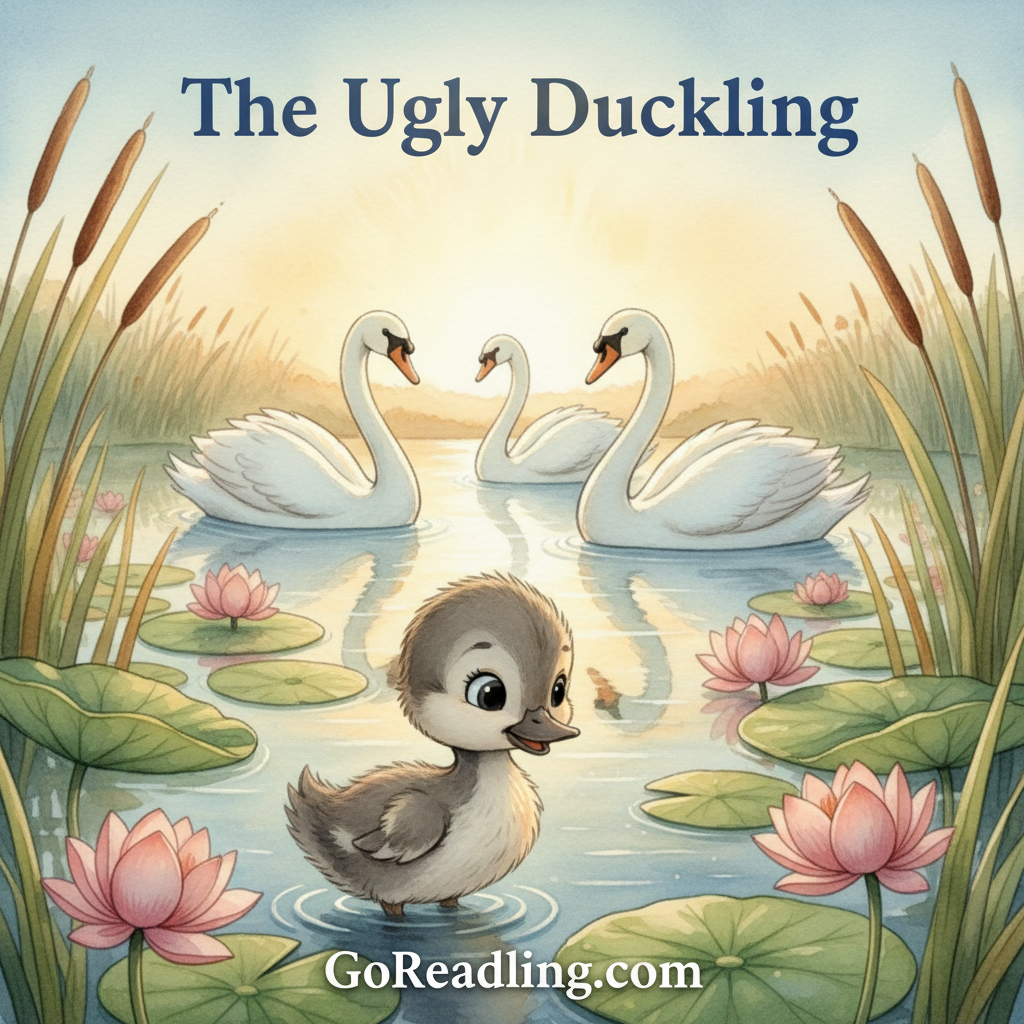
The big grey egg hatched the next morning. The shell cracked with a sound like a small stone splitting, and out tumbled a duckling that was nothing at all like its brothers and sisters. It was large, for a start, nearly twice the size of the others. Its down was not golden yellow but a dull, mousy grey. Its feet were too big. Its neck was too long. Its beak was wide and flat in a way that looked, to the other ducklings, rather funny. It blinked at the world with dark, bewildered eyes, sneezed once, and fell over sideways. The five yellow ducklings stared. The mother duck stared. Then she gathered herself, waddled over, and nudged the grey duckling gently to its feet. 'Welcome, little one,' she said softly. But even as she said it, a small, worried crease appeared between her eyes, because she could see already that this child was different, and she knew, with a mother's instinct, that being different in this world was not always easy.
The trouble started almost immediately. When the mother duck led her brood down to the lake for their first swim, the five yellow ducklings glided across the water like tiny golden boats, neat and graceful and perfectly in formation. The grey duckling splashed and floundered and kicked up waves that rocked his siblings sideways. His big feet churned the water into foam. His long neck bobbed and dipped at awkward angles. He could swim, there was no doubt about that, in fact he could swim rather well, but he did it in a way that looked clumsy and strange and nothing at all like the others. The farm animals noticed. The rooster on the fence post crowed with laughter. The cat on the barn roof narrowed her eyes. The old goose by the gate shook her head and muttered, 'What sort of duckling is that? He is the most peculiar creature I have ever seen.' The grey duckling heard every word, and though he did not fully understand what was wrong with him, he understood perfectly well that something was.
The other ducklings were not kind to him. Children can be cruel without meaning to be, and sometimes even while meaning to be, and the five yellow ducklings fell into the easy habit of excluding their grey brother from their games and their conversations and their comfortable little huddle at night. They would chase each other around the pond in a joyful, splashing circle, and when the grey duckling tried to join, they would paddle away, leaving him alone in the middle of the water, watching them go. 'You are too big,' they would say. 'You splash too much. You do not look like us.' The grey duckling would tuck his head under his wing and float there, trying very hard not to cry, because even at this young age he had begun to learn that crying did not change anything. It only made your feathers wet.
The worst of it came from the farm animals. The turkey, who considered himself the most important bird on the farm and made sure everyone knew it, would puff up his chest and gobble loudly whenever the grey duckling walked past. 'Look at that ugly creature,' he would announce to anyone who would listen. 'Have you ever seen such a sight? Too big for a duckling, too grey for a gosling, too awkward for anything at all. He does not belong here.' The hens would cluck their agreement. The pig would snort from his mud wallow. Even the farm dog, who was generally a kind soul, would look at the grey duckling with a puzzled expression, as if trying to work out what sort of animal he was. The grey duckling began to believe what they said. He would look at his reflection in the lake and see what they saw: a big, grey, ungainly bird that did not fit in anywhere at all. He did not yet know that reflections can lie, especially when you look at them through the eyes of loneliness.
His mother tried to protect him. She would tuck him under her wing at night and tell him that he was special, that being different was not the same as being wrong. 'You are my child,' she would say, 'and I love you exactly as you are.' But even her love could not shield him from the daily sting of rejection. She could not follow him everywhere. She could not stop the whispers or the pointed looks or the way the other ducklings edged away from him at feeding time, leaving a gap around him as if his difference were something contagious. The grey duckling loved his mother with all his heart, but he could feel himself becoming a burden to her. She had to defend him constantly, and it was wearing her out. He could see the tiredness in her eyes, the way her shoulders drooped when yet another farm animal made a cruel remark. He made a decision, quietly and alone, in the blue hour before dawn. He would leave.
He slipped away from the nest while the others were still sleeping, their golden heads tucked under their wings, their small bodies rising and falling with each peaceful breath. The morning was grey and misty, and a thin rain was falling, the kind of rain that is almost not rain at all, more like the sky breathing moisture. The grey duckling waddled down to the lake, slipped into the water, and began to swim. He did not know where he was going. He knew only that he could not stay. He paused once, at the far end of the reeds, and looked back. The farm lay in the mist like a watercolor painting, soft and blurred, already fading. He could just make out the nest, the round shape of his mother among the rushes, her feathers ruffled by the breeze. He wanted to call out to her, to say goodbye, to tell her that he was grateful for every word of kindness she had ever spoken. But the words caught in his throat, and the mist thickened, and the farm grew smaller behind him, the red barn, the stone farmhouse, the fence where the rooster perched, the nest where his mother slept. He felt a pain in his chest that was sharp and deep, the pain of leaving the only home he had ever known, the only creature who had ever loved him. But he kept swimming. The lake was wide and calm, and the mist wrapped around him like a soft grey blanket, hiding him from the world and the world from him.
The grey duckling wandered for many days. He swam through marshes thick with reeds and bulrushes, where dragonflies hovered and frogs croaked their endless evening songs. He crossed meadows where wildflowers grew in great sweeping drifts of purple and gold and white, and the air was sweet with the scent of clover and warm grass. He slept under hedgerows and in the hollows of old willow trees, curling himself into the smallest shape he could make, trying to take up as little space as possible, as if by making himself small he could make his sadness small too. He ate what he could find, water beetles and pond weed and the occasional handful of grain spilled from a farmer's cart. He was lonely. He was hungry. He was afraid. But he kept going, because somewhere deep inside him, beneath the loneliness and the hunger and the fear, there was a tiny, stubborn flame that refused to go out, a flame that whispered, You are more than what they said you are.
One evening, as the sun was setting and the sky was streaked with the most extraordinary shades of pink and gold and lavender, the grey duckling came to a marshy pond surrounded by tall reed beds. A family of wild ducks lived there, and they watched him approach with cautious eyes. The mother duck, a handsome mallard with glossy green-brown feathers, paddled over to inspect him. 'What are you?' she asked, tilting her head. 'I am a duckling,' he said, though even he was not entirely sure anymore. 'You do not look like any duckling I have ever seen,' she said. 'You are very grey. And very large.' Her ducklings, who had been hiding behind her, peeked out and giggled. The grey duckling felt his heart sink. It was happening again. But the mother duck was not unkind. 'You may stay for a while,' she said. 'There is plenty of food. But keep to yourself and do not cause trouble.' The grey duckling thanked her and found a quiet corner of the pond, away from the others, and settled in.
He stayed at the marsh pond through the long, hot days of summer. He was tolerated but not welcomed, accepted but not loved. The wild ducks allowed him to swim in their pond and eat their food, but they never included him in their conversations or their games. He was always on the edge, always watching from a distance, always the one left standing alone when the others clustered together. He tried to be useful. He would warn them when he spotted hawks overhead. He would find the best patches of duckweed and let the others eat first. He would stay up late on watch while the others slept, his dark eyes scanning the starlit water for foxes or weasels. But none of it seemed to matter. He was still the grey one, the odd one, the one who did not belong. At night he would look up at the stars and wonder if there was anywhere in the whole wide world where a big, grey, awkward bird like him could feel at home.
Autumn came, and the world changed. The leaves turned from green to gold to copper to a deep, rich red, and then they fell, spinning and dancing in the cool breeze, carpeting the ground in a rustling patchwork of color. The air grew crisp. The mornings were cold, with frost silvering the reeds and turning the surface of the pond into a mirror that reflected the pale, watery sky. The wild ducks began to talk about flying south. Every year, they said, when the cold came, they flew to warmer lands where the water never froze and food was plentiful. They would leave soon. The grey duckling listened and said nothing. He could not go with them. He was not one of them, and they had not invited him. When the morning came and the flock rose into the sky in a great, noisy, beating of wings, the grey duckling sat alone on the empty pond and watched them go, growing smaller and smaller until they were just a dark line against the grey sky, and then nothing at all.
It was then, on that cold, quiet morning, that something happened which the grey duckling would remember for the rest of his life. As he sat alone on the deserted pond, feeling more lost and alone than he had ever felt before, a sound reached his ears, a sound so beautiful it made him catch his breath. He looked up. High above him, flying in a perfect V formation against the pale sky, was a flock of the most magnificent birds he had ever seen. They were large, much larger than ducks, with long, graceful necks and wings that seemed to span half the sky. Their feathers were pure white, gleaming like fresh snow in the autumn sunlight. And the sound they made, a clear, trumpeting call that echoed across the marshes and the meadows and the distant hills, was the most beautiful music the grey duckling had ever heard. Swans. They were swans. He did not know their name or anything about them, but something in his chest stirred and ached and yearned, as if a part of him recognized them, as if some deep, buried instinct was whispering, Those are your people.
Winter arrived, and it was harsh. The temperature dropped and dropped, and the pond froze from the edges inward, the ice creeping a little further each night until only a small circle of open water remained in the center. The grey duckling huddled in this shrinking pool, paddling constantly to keep the water moving, his feet numb and his feathers stiff with cold. Snow fell in thick, silent blankets, covering the world in white. The reeds cracked and bent under the weight of ice. The sky was a flat, featureless grey that seemed to press down on the earth like a lid. Food was almost impossible to find. The grey duckling ate what he could, scraps of frozen pondweed, the occasional hibernating snail, but it was never enough. He grew thin. His feathers lost their gloss. He was cold all the time, a deep, bone-deep cold that no amount of huddling or shivering could drive away.
There were days when he thought he could not go on. The loneliness was worse than the cold, worse than the hunger, worse than anything. He had been alone for so long that he had almost forgotten what it felt like to have someone speak to him with kindness. He would close his eyes and remember his mother's voice, warm and gentle, saying, You are my child, and I love you exactly as you are. The memory was like a small flame in the darkness, barely enough to warm his frozen heart, but enough to keep him alive. He thought about the swans, too. He thought about their beautiful white wings and their trumpeting call and the way they had flown across the sky with such purpose and grace, as if they knew exactly where they belonged. He wondered if he would ever feel that certainty, that sense of home. He did not know. But he kept going. He kept his feet moving in the freezing water. He kept his eyes open. He kept the small, stubborn flame alive.
One morning, when the grey duckling was at his lowest, his feathers matted and dull, his body thin and trembling, something miraculous happened. A farmer found him. The man was walking along the frozen edge of the pond, checking his fences after a night of heavy snow, when he saw the grey bird huddled in the last patch of open water. The farmer was a kind man with rough hands and a soft heart. He waded out through the snow and the ice, scooped the duckling up in his big, warm hands, and carried him home. The farmhouse kitchen was warm and bright, with a fire crackling in the grate and a kettle singing on the stove. The farmer's wife wrapped the duckling in a blanket and set him by the fire. The farmer's children, two small girls with rosy cheeks and wide, fascinated eyes, sat on the floor and watched him with the concentrated attention that only children can give to a small, bewildered animal. The grey duckling drank warm water from a bowl and ate bread soaked in milk, and slowly, very slowly, the cold began to leave his bones.
He stayed with the farmer's family through the rest of the winter. They gave him a box by the fire and fed him kitchen scraps and leftover grain. The two little girls adored him and would sit with him for hours, stroking his grey feathers and talking to him in soft, serious voices about their dolls and their games and the rabbit they wanted for Christmas. The family cat was less enthusiastic. She had claimed the fireside as her territory long before this strange grey bird arrived, and she made her displeasure known by hissing and arching her back whenever he waddled past. The dog, a big, gentle sheepdog, was indifferent but occasionally thumped his tail in what might have been welcome. The grey duckling was grateful for the warmth and the food, but he knew, in the way that wild things always know, that this was not his home. It was a shelter, a kindness, a place to rest and heal. But when the spring came, he would have to go.
Spring came gently that year, like a quiet friend arriving at the door without knocking. The snow melted first from the south-facing hillside, revealing patches of green so bright they hurt the eyes after months of white. Crocuses pushed through the mud, purple and yellow and white, each one a tiny declaration of hope. The ice on the pond cracked and thinned and finally broke apart, floating in white pieces across the dark water like tiny boats sailing nowhere. The willow trees put out their first tentative green buds, soft as caterpillars. Blackbirds returned and began to sing from the rooftops, their liquid melodies pouring out over the waking land like warm honey. The air changed. It lost its sharp, iron edge and became soft and damp and full of promise, carried the scent of wet dark earth and new growth and something sweet and indefinable that was simply the smell of spring itself. The grey duckling felt it in every feather. Something was stirring inside him, a restlessness, a longing, a call that he could not possibly ignore.
He left the farmhouse on a morning in early April, slipping out through the kitchen door while the family slept. He did not want to say goodbye. Goodbyes were painful, and he had already had too many of them. He waddled down the lane and across the meadow, his feet squelching in the soft, wet earth, and found his way to a large, clear lake that he had never seen before. It was a beautiful place, fringed with willows and bordered by meadows full of wildflowers. The water was so clear he could see the pebbles on the bottom and the fish swimming lazily among the weeds. He slipped into the water and felt, for the first time in months, truly himself. The cold had made his body strong. His feathers were thick and sleek. His wings, which he had hardly used before, felt powerful, as if they had been growing and strengthening all winter without him noticing. He stretched them wide, wider than he had ever stretched them before, and was surprised by how far they reached.
And then he saw them. Three swans, gliding across the far side of the lake, their white feathers reflected perfectly in the still water so that they seemed to float between two skies. They were impossibly beautiful, serene and graceful, moving through the water with a slow, stately elegance that made everything else in the world seem hurried and clumsy. The grey duckling's heart began to pound. He remembered the flock he had seen in the autumn sky, the trumpeting call, the ache of recognition. He wanted to swim toward them. He wanted it more than he had ever wanted anything. But he was afraid. What if they turned away from him? What if they looked at him with the same cold, dismissive eyes as the farm animals and the wild ducks? What if they saw what everyone else had always seen, an ugly, grey, worthless bird that did not belong anywhere?
He almost turned away. He almost swam back to the shore and disappeared into the reeds and spent the rest of his life hiding, alone and ashamed. But then the small, stubborn flame inside him, the flame that had burned through all the loneliness and the cold and the cruelty, flared up one more time. No, it said. You have come too far. You have survived too much. Find out who you are. He took a deep breath. He lowered his head, a gesture of humility and surrender, offering himself up to whatever judgment might come. And he began to swim toward the swans. As he moved through the water, something caught his eye. His reflection. He looked down, and what he saw stopped him completely. Staring back at him from the still, clear water was not a big, ugly, grey duckling. It was a swan. A young swan with sleek white feathers and a long, graceful neck and dark, beautiful eyes. He turned his head. The reflection turned too. He stretched his wings. Long, powerful, white wings unfurled beside him, catching the morning light.
He was a swan. He had always been a swan. All those months of loneliness and pain and wandering, all that time spent believing he was ugly and wrong and worthless, and the truth had been there all along, hidden beneath the grey down of childhood, waiting for spring to reveal it. The tears that fell from his eyes were not tears of sadness. They were tears of wonder, of relief, of a joy so deep and overwhelming that it felt like drowning and flying at the same time. The three swans saw him and glided over. They did not mock him or turn away. They circled him gently, brushing their necks against his in a gesture of welcome and recognition. They saw what he was. They had always known, even before he did. One of them, the eldest, a magnificent bird with feathers like polished ivory, looked at him with kind, steady eyes and said, simply, 'Welcome home.'
The news spread among the creatures who lived around the lake. The sparrows chattered about it in the hedgerows. The frogs discussed it from their lily pads. The old heron, who had seen many things in his long life, nodded wisely and said he had always suspected. The grey duckling, who was not a duckling at all and never had been, swam with the other swans across the lake, and for the first time in his life he felt the extraordinary peace of belonging. He was not too big. He was not too grey. He was not too anything. He was exactly, perfectly, wonderfully right, and the world that had once seemed so hostile and confusing now seemed bright and beautiful and full of possibility. Children from the nearby village came to the lake to feed the swans breadcrumbs, and they pointed at the young one and said, 'Look at that new swan. He is the most beautiful one of all.' And the young swan heard them, and he tucked his head shyly under his wing, because beauty was still a strange and unfamiliar feeling, like wearing a coat that belongs to you but that you have not yet worn enough to feel comfortable in.
As spring deepened into summer, the young swan grew into his new life. He learned the language of swans, the soft, murmuring calls they used to comfort each other, the sharp, trumpeting warnings they sounded when danger was near, the deep, resonant songs they sang at dusk when the lake was still and the sky was streaked with amber and rose. He learned to preen his feathers, drawing each one carefully through his beak until it lay smooth and bright, and he marveled at how white they were, how clean and perfect, as if each feather were a small miracle of engineering. He learned to fly, launching himself from the water with great sweeping beats of his white wings, climbing higher and higher until the lake was a blue oval far below and the world spread out around him in an endless patchwork of green fields and silver rivers and dark forests. Flying was the most extraordinary thing he had ever experienced. It was freedom made physical, the wind in his feathers and the earth falling away and nothing between him and the stars but sky. He would soar for hours, following the curves of the river, circling above the meadows, riding the warm updrafts that rose from the sun-baked fields, and he would think, This is what I was made for. This is who I am.
He thought about his mother often. He hoped she was well, that she had raised her five golden ducklings safely and that they were swimming happily on the farm pond, chasing dragonflies and basking in the sun on the warm muddy bank where they had all been born. He did not blame her for anything. She had loved him as best she could. She had called him special when the world called him ugly. She had given him the warmth and courage he needed to survive those first terrible months, and that gift had carried him through the winter and the loneliness and all the dark days when giving up would have been so easy. He wanted to go back and see her, to stand before her as a swan and show her that the strange grey egg she had tended with such patience had contained something beautiful after all. He imagined her face, the surprise and the pride and the tears of joy. Perhaps one day he would. Perhaps, when the autumn came and the swans flew south, he would pass over the farm and circle low, and she would look up and recognize something in his dark eyes, a glimmer of the awkward grey duckling she had once called her own. For now, he was content to swim on his lake with his new family, the water smooth as silk beneath his breast, the willows trailing their green fingers in the shallows, the sky above him wide and blue and endless.
One evening, as the sun was setting and the lake was painted in shades of gold and pink, the young swan swam to the center of the water and floated there, still and quiet. The other swans were already sleeping, their heads tucked under their wings, their white bodies glowing faintly in the fading light like large, peaceful lanterns floating on the surface. The young swan looked at his reflection in the water, this beautiful, graceful creature that he was still learning to recognize as himself. He thought about the journey that had brought him here, the nest in the reeds, the farm where he was mocked, the long lonely wandering, the frozen pond, the kind farmer, the first glimpse of the swans against the autumn sky. Every part of it had been necessary. Every hardship had shaped him. Every moment of pain had been a step on the path to this, to belonging, to home. He spread his wings wide, catching the last golden rays of the sun, and he was beautiful, truly and completely beautiful, not because of his white feathers or his graceful neck, but because he had survived.
And that, dear little one, is the story of the Ugly Duckling, who was never ugly at all. He was simply a swan in the wrong nest, a beautiful creature who had not yet discovered what he was. Remember, as you lie snug in your bed tonight with the stars keeping watch outside your window, that sometimes the things that make you feel different are the very things that make you special. The world may not always see it right away. It may take time. It may take patience and courage and a long, cold winter. But spring always comes, and with it the truth that you were extraordinary all along. You do not need to be like everyone else to be wonderful. You just need to be yourself, fully and bravely and without apology. Goodnight, little one. Sleep well, and dream of still lakes and white wings and a world that is waiting, with open arms, to welcome you home.